
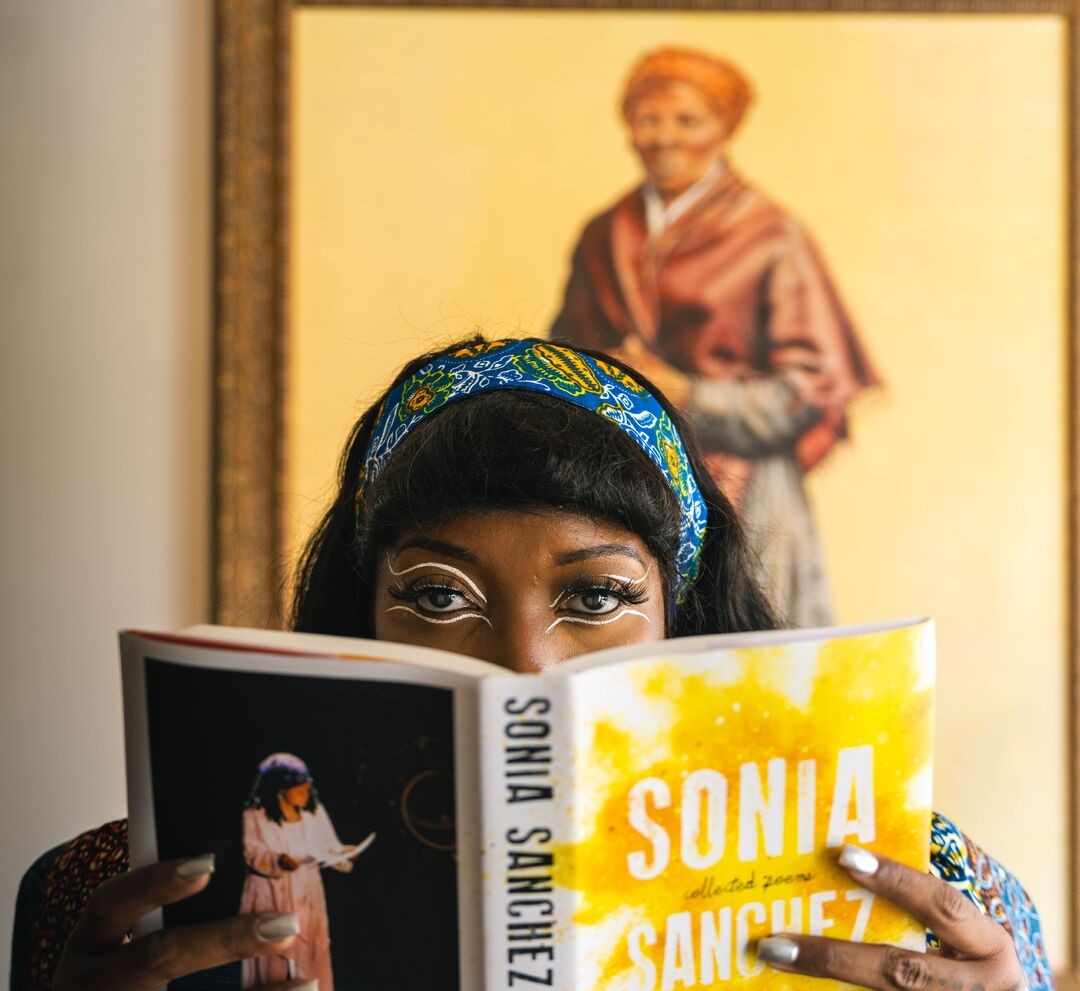
According to Fortune, mere months after 600,000 Black women are disproportionately fired from the workforce, largely due to Trump’s policies, and at a time when we represent the fastest-growing group divesting from North American corporate predatoriness to invest in our own businesses, Shut Up and Read: A Memoir From Harriett’s Bookshop by Jeannine A. Cook is a guide.
Cook is the keeper of two avant-garde bookshops—Harriett’s in Philadelphia and Ida’s in South Jersey—and an ever-changing literary installation that moves around Paris—Josephine’s. At the time of writing, it’s less than a week before Shut Up and Read hits shelves. I finished reading it in under two days, which says a lot, considering I’m a single parent of multiple toddlers.
A lionhearted page-turner, Shut Up and Read features propulsive narrative prose interwoven with excerpts of interviews Cook has conducted with renowned literary giants from Sonia Sanchez to Alice Walker, lyrical meditations reflecting on a shopkeeper’s mindset and myriad roles, a personified illness that is as vivid as the actual people Cook brings to life on the page, and letters Cook writes to ancestral guides. These literary modalities come together to provide an intimate, behind-the-scenes glimpse into the Olympian-sized feats Cook overcame while creating some of the most celebrated bookshop experiences.
Through her writing, Cook becomes the sister-friend we all need. The one who tells us to “Shut up and get on with it” while also affirming, “You’re on the right path. Just listen to your guides!” Her literary voice and lived experiences resonate because they’re rooted in our ancestral traditions and shared spiritual tools.
It’s a misty Wednesday morning in early March when I have the fortunate opportunity to sit down with visionary and the creatrix, at Harriett’s bookstore in Philadelphia.

The Rumpus: Six months ago, your debut novel, It’s Me They Follow (Amistad, 2025), was published. On March 10th, less than a week from today, your memoir will hit the shelves. Two books in less than a year while still organizing events, interviewing writers, ordering books, creating space for community, running two bookstores and a literary installation overseas, and having a grandchild just six weeks ago. How has all of this been for you?
Jeannine A. Cook: You dream and envision, but it’s nothing like the moment when the time finally arrives. That’s the power of having vision—you see things before they exist in the natural realm. Sometimes, that’s also the enigma of being a visionary. My friend was talking to me the other day about the cost of being a creative. It comes with a lot of beauty, but also weight, right? I love using the birthing process as a metaphor because that labor is no joke, and the closer you get to giving birth, the more intense the labor really becomes. But you know that on the other side of it is a beautiful gift—if you can make it through that labor process.
Forgive me if I get emotional during all of this, because it’s just part of it. My father passed away while I was writing the end of It’s Me They Follow. I went to Virginia to finish the book, thinking, “Oh, I need a quiet place to write. I’m gonna go to my grandma’s house.” I needed that kind of nana love. When I got there, it turned out I was actually there to walk my father over to glory. So I was with my nana for a reason, because she needed to pass down how to do that particular kind of work. Watching the seasons of death and birth happen six months apart is pretty phenomenal.
Rumpus: My deepest condolences on your father’s passing. He was a significant part of Shut Up and Read. The two of you often laugh together about one thing or another, even during times of great stress. You wield that tool—humor—effectively, often to hide deep pain. “Absurd ambivalence,” you call it?
Cook: It’s the idea that you can feel two things at once. Yeah, that’s why my father is such a good person to tell this story alongside. It’s because that’s how he was. That’s how I was raised. I think that’s culturally how we are brought up. How do people survive in the hull of a ship? How did they make it? Like, literally, when I think about that, like, how did you cross the Middle Passage? As a seven- or eight-year-old child, in the hull of a ship, chained to someone. How did they survive? I was on a tour in the Keys, and it happened to be during the Day of the Dead. A community wanted to talk about a ship that washed up onto their shores filled with children, the oldest being, like, nineteen or twenty, but with an average age of eight to nine.
When we think about slavery, we don’t usually focus on the children, but this ship only carried children. Half of those children were very sick, while the other half were not. When they disembarked and were given their own encampment on the beach, it was said that the children immediately started making beautiful clothing out of whatever they could find, creating shell necklaces, and adorning themselves with crowns. At night, they would dance and sing. This was their tradition.
We are a joyful people, and our joyfulness is part of our subversiveness, right? We use humor as a form of subversion. We play that trickster role on society, where they don’t understand what we’re talking about. We talk about multiple things at once, and we speak ambivalently. So, as I’m literally suffering and experiencing what I believe to be one of the hardest things I’ve ever gone through in my life, I’m also writing Lorene [Cary] to tell her a joke about how much the pain hurts. That is our tradition. Like the children, literally fresh off a boat, creating themselves, adorning themselves, establishing ritual, dancing, and using song, we make everything beautiful.
Rumpus: Your memoir highlights Afrikan diasporic traditions and spiritual cosmology as central elements of your life’s work. You mention Yemaya when discussing Harriet Bookshop’s design. The Kemetic goddess Auset, later known as Isis in Greek mythology, draws you to Paris. You communicate with your ancestral guides: Harriet Tubman, Ida B. Wells, and Josephine Baker. Talk to me about why making our spiritual traditions a focal point of the memoir was so important to you.
Cook: Because we have a tradition. Early on, when I was writing the first draft, my agent, Ms. Marie [Brown], told me, “Jeannine, I’m glad you didn’t feel like you needed to explain things. If you’re speaking to your cousin, you don’t have to explain about Aunt Shirley. Your cousin already knows about Aunt Shirley. You don’t gotta say, ‘Well, Aunt Shirley was this person who…’ Y’all both have an inside understanding about who Aunt Shirley is.” The books are for who they’re for. I’m not trying to make you understand. I’m not an evangelist. I’m not trying to convert. I knew who Harriet’s was for. I knew who Ida’s was for. They’re for those who walk through those doors, and they just get it. My dad used to say, “You’re mixing history and mythology.” Yeah, I am. I’m living out those two existences. It works for me. And it works for my cousins. Not everything is for the masses. We lose tradition and value when we try to make it palpable for everyone.
Rumpus: In Shut Up and Read, you write, “It’s summer 2024, and I have just signed a two-book deal with HarperCollins. Three months to write an upmarket romance, the one genre of book that I just started to read, and three months to write a real raw memoir right after that… This is an Olympic-sized task.” Jeannine, your memoir is straight up lionhearted. An unguarded retelling of how your bookshops—Harriet’s in Philly, Ida’s in South Jersey—and literary installation in Paris came to be. Even though that quote was about writing two books within a six-month period, to me, it’s relevant to your entire journey of creating literary third spaces. Were you ever tempted to throw in the towel? To give up?
Cook: Every day. Every day. Literally every day, the thought passes through my mind like, “What if you just stop? Why are you doing all this?” especially when I feel like I don’t hit my own mark of success or my own standard. When you have a vision and can see something so clearly in your mind’s eye, and then as you’re walking and watching it come to fruition, when it doesn’t hit, it feels like, “Oh, this isn’t it yet.” I love that Isabel Wilkerson can take ten years to sit with her text and massage that thing. That’s a luxury that’s not easy to come by. And so, yeah, it was a worthy Olympian journey. My grandma told me, “Jeannine, you’ve been training for this moment your whole life. And so you just have to walk in your authority.” That’s what she keeps telling me, “walk in your authority.” And I have to accept that part of it, too. And any parts that are not up to the standard or the vision I hold now, I get to revisit and revise.
Rumpus: Hmmm, your point about taking the time to sit reminds me of a character in Shut Up and Read, Ms. Graves. She is your personification of Graves’ Disease. It’s Ms. Graves who slows you down when the demands of your bookshops and creativity force you to move, and move some more. It’s Ms. Graves who demands you rest when your work—the trolley tours, interviews, community gatherings, et cetera—would rather you stayed up all night. How are you finding ways to get balance these days, without Ms. Graves having to pull up on you?
Cook: I’ve been spending more time with elders, especially the octogenarians and older—Ms. Marie in her 80s, my grandmother also in her 80s, and Mama Sonia [Sanchez], who’s now 90. These women have been through a lot, and when they’re your friends, you start becoming like them. Nana talked about her nighttime routine, which takes a good two or three hours of decompression. I was like, “Oh, that’s how that looks?” I’ve been observing how they behave in the world, and I’ve begun to adapt and adopt some of their ways. I’m also learning from what they say to avoid. We have elders for a reason, right? Ms. Marie mentioned the other day, “Jeannine, I always wonder why more people don’t call me and ask me questions, even though you called me with a thousand gazillion questions.” What I appreciated about my conversation with Alice Walker was that she said, “I consider my journals to be medicine. There’s nothing off-limits about what I’ve experienced in this life because that is my job as your elder.” They’re open vessels. That’s why I like talking to them.
Rumpus: Speaking of open vessels, you include letters that you’ve written to your guides, namely Harriet, Ida, and Josephine, in your memoir. When reading them, I felt like I was sitting with you at your boveda, or ancestral altar, watching you light the candle, get comfortable on a pillow, pour your libations before expressing your dreams, your desires, your tribulations, and trials, and also asking questions. Those letters are so deeply personal and beautiful. Why the decision to include them?
Cook: Because that’s my way. It’s my real way. Talking to them and listening to them is what helps me. It’s what guides me. People who know me might say, “Yup, she’s over there talking to Ms. Harriet again.” There’s a part of society that’s told us certain versions of our practices and traditions aren’t valid, or they’re strange, or they don’t fit. So, of course, right now, they’re having a saint conversation about Toni Morrison. Of course, they are, right? Because it’s the perfect time for that. But who else is gonna venerate our ancestors if not us? Who else has the right or responsibility to do it? Why would we wait for someone else to do it? Why would we think someone else could do it better than we can? So, yeah, it’s just my way. And I sit with them much like I sit with the octogenarians, and that’s why I said maybe Ms. Graves makes it possible for me to hear beyond the grave. Like, maybe part of being one of her students is that you get a thinner veil.
Rumpus: Your point about hearing makes me think about the use of sound in this work. Sound and place are at the heart of Shut Up and Read. For example, you were drawn to Philly not because of its architecture or food scene, but because of its sound. You write, “I first arrived here twenty years ago, enticed by an accent of elongated a’s and the replacing of proper nouns with ‘jawns.’” In addition to sound, you anchor readers with vivid descriptions of place, from Fishtown to France, your undergraduate home to Harriet’s underground space. I’m curious, in terms of the craftsmanship of this memoir, how were you thinking about voice and place?
Cook: When you’re raised by a blind woman, sound becomes a part of everything. It was ingrained in our fabric. That was part of what it meant to be raised by a blind woman: to use sound as a way to communicate because she couldn’t see things. I remember as a child, we’d say, “Step up, step down.” That was how we communicated in public because she didn’t want to walk with a cane or want people to know she was blind. We’d use different sound signals so she knew what was happening around us, whether a space was safe or not, or how she should move through it.
I think that space and sound just go together, especially because much of my work is about space building and placemaking. For example, when you enter Harriet’s, you might hear Toni Morrison on audio. People often ask, “Who is that? I know her!” just from her voice and the way it sounds—nostalgia, connection, flashbacks, and so on. I’m glad you picked up on that because I’m never quite sure how people will respond.
Rumpus: Your book took me all the way down several internet rabbit holes because it introduced me to Black women writers from Philly I hadn’t heard of—Nellie Bright, Lorene Cary, Barbara Chase-Riboud, to name a few. Your memoir, like your bookshops, connects readers to Black women writers, artists, and creators beyond yourself. Was that the work you endeavored to accomplish with this memoir? Do you see this memoir as a complement to your role as a bookseller?
Cook: I honestly thought Harriet’s was gonna be the spot where I was just gonna be sitting there by myself writing, and that occasionally someone might drop by, probably one of my friends, to say “What’s up?” or have a tea. I’m glad my guides didn’t show me the full vision. Because I think, at that point, I would have thought, I’m not capable. I wouldn’t have taken it on.
And often, I think that’s how it works with me—they’re like, “We ain’t gonna show Jeannine this whole thing.” Like when my mom was losing her sight, she used to look at things through a tiny peephole. She would do this all the time: just make a narrow tunnel of what exactly she was trying to see, blocking out everything else. And it feels like that to me. When I first started, I could just look through a narrow tunnel, and the tunnel would say, “You need to just sit in here, shut up by yourself, and write, and get these books in here.” I feel like Ms. Harriet made it simple for me. She clarified the whole vision very simply for me: “All you’re gonna do is sit in there with books and write.” I was like, “Oh, I could do that!”
One of the lines from the memoir that always resonates with me—that I often go back to, even for myself—is, “A shopkeeper creates a sanctuary for others until she has the will to do so for herself.” That’s what I believe has happened through these spaces, through the shops, and also through the memoir. I felt like I had the impetus; I could do it for my community, right? Like I could go in for my folks, only to realize that learning how to serve your community is actually a roundabout way of learning how to hold space for yourself. And that’s the same with the memoir. You’re telling your story, and hopefully it inspires others, but also, you need this for yourself. You need a place to put some of it down. Especially after everything that happened with my dad, I just felt like I needed to write Shut Up and Read. To go through that process was more than I could have ever imagined. Not to mention what it would do for others. So, it’s a dance between making space for myself and making it useful for others. Hopefully, it gets to do both.

Click here to subscribe today and leave your comment, or log in if you’re already a paid subscriber.