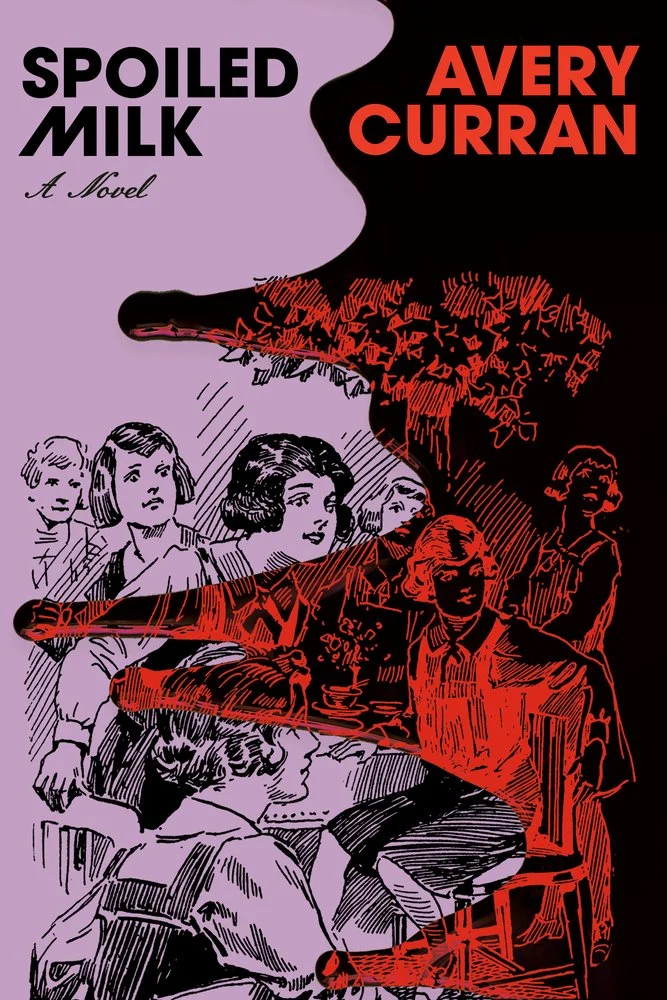
Take heart, dear readers: the proud canon of Books About How Being A Closeted Virgin Can Make You Insane has just received an excellent new entry. Yes, finally we have a Pretty Little Liars tale that’s set in 1920s Britain and soaked in ectoplasm. Here, at last, is a boarding school novel containing characters and content eerily resonant with basically every track on Mitski’s 2014 album Bury Me At Makeout Creek. (RIP, Emily Locke, you would have loved scream-singing, “one word from you and I would jump off of this ledge I’m on, baby.”) Avery Curran’s debut novel, Spoiled Milk, is a triumph of mood and an earnestly frightening story about the horror of being a girl, the horror of empire, the horror and majesty and horror, yes, of that one blonde bitch who rules the universe, their universes, large and small all over. If I knew any high-school-aged girls, especially any of the more sullen variety, I would press the delightful American hardcover, pallid lavender giving way to shiny black and blood red ooze on the dust jacket, into their hands with an urgency they’d understandably bristle at and possibly post about on TikTok. But I am a childfree lesbian in a circle of childfree lesbians and thus am telling readers of The Rumpus instead. Perhaps some of you will give word to the youth– after buying and enjoying the book for yourself, that is. While I would have gone absolutely bonkers for it as a young person, this is an adult novel, and an adult novel extraordinarily well-suited to helping one reconnect with their inner rotten gay teen. Spoiled Milk is a cruel, nasty pleasure which, over several weeks, has not loosed its claws from their sticky anchoring in my poor pink brain; I love it so much.
The text opens with a charming dramatis personae introducing us to six living schoolgirls and one schoolgirl newly deceased. The dead girl is Violet Kirsch. On the night of her eighteenth birthday, Violet, this lithe and agile, dynamic girl, toppled over a railing out of the blue, cracking her lovely neck. Something about her death is clearly wrong, unnatural. But, remember, they’re all English, and it’s 1928, and Briarley School for Girls has standards to uphold. The grave show must go on, classes conducted, bells rung, even as cold milk curdles and pristine looking apples ooze worms and rot. The complicated power vacuum that Violet leaves behind her at Briarley will shortly be the least of her classmates’ problems.
Violet, of course, was a beautiful, wealthy blonde and possessed the necessary savvy to leverage these assets to her advantage. She was worshipped throughout the school. Though dead and buried, like Laura Palmer before her (honestly, RIP, David Lynch, you would have loved Spoiled Milk!), she is not quite gone. Violet haunts her old chums well before the spectral activity kicks off in earnest. The shuddering fact of her short life reverberates within the girls who loved and loathed her, ripples spreading from that place where something brightly shining slipped beneath darkness like a stone dropped in a lake. Narrator Emily, a wonderfully unpleasant girl at war with the threat of self-knowledge, is, of course, unmoored by the loss of her best friend. That she was very obviously in extreme and ruinous homosexual love with Violet is a truth Emily is unable to look at or touch. Instead, she lashes out at Violet’s other most ardent admirers. She spends nearly half the book convincing herself and, to varying success, her friends, that Violet was murdered by their French teacher, a young woman they call only “Mademoiselle” with whom Violet may have been having an affair of sorts. Similarly, Emily struggles, or, more often, does not bother struggling, to find any kindness for Evelyn Hart, a fellow Violet devotee. For fear of seeing in Evelyn a mirror of her own desires, Emily writes the girl, who is, to be fair, a bit annoying in the way anyone who wants to be class prefect must definitionally be, off as a sanctimonious goody-two-shoes, picking at her at every turn. “A curl had come out her plaits and bounced as she ran; I vaguely thought of pulling it like a schoolyard bully.” It’s a biting, spitting sort of lust triangle, these horny bad-tempered girls circling one another and, always, the hot blonde they can’t stop thinking about, summoning in séances, hoping might save them from their growing nightmare.
Those little freaks share a dormitory with a perfectly adorable teen couple in butch/femme sweetie pies Alice and Dot. Emily experiences their easy happiness, performed quite openly, if, according to the period, and to the liminal hothouse environment of an all-girls school, without label or explanation, as a dire threat. She once spies Alice dropping a teeny peck on Dot’s lips and nearly gives herself an aneurysm. All the while, sensitive, dollish Dot and her Alice, the textbook definition of strapping, all broad-shoulders and liveliness, enjoy being together without the crises of moral identity and pride which leave Emily and Evelyn biting at one another like ill-loved dogs. Two straight girls, if you can believe, round out the class. Dear, sweet Sophie is, “decent, excitable, good at dancing and clever at first aid.” An aside about Sophie’s classic teen passion for the tragic romance of the Titanic has returned to my mind with a wince more than once. Gratefully, I next recall,“and then Violet asked whether we were sadder about the Titanic or the Great War, which caused a row that lasted most of February,” and I am very soothed indeed. Marion is smart and self-assured. She emerged as a favorite for me, the protective, elegant Violet Kirsch skeptic. Marion’s personal glamour, unlike Violet’s, is not about dominion over others. Naturally, they have beef. When the perpetually scandalized Emily is breathless at the thought that Marion would know anything about lesbians, Marion tells her, “Emily, I read, for heaven’s sake. Baudelaire. The papers. Honestly, it isn’t difficult.” These girls, and their relationships to one another, are vivid and funny and tender, and when the novel inevitably pivots from teen squabbling and abortive séances into a slasher film sequence of bloody violence, the gang dropping in number almost with the turn of the page, it is great fun, a well-earned, exciting denouement, and so horrifically wrenching.
The drama of Spoiled Milk is about more than allowing or not allowing one’s self to fantasize about hooking a hand beneath your classmate’s school-issued pinafore. Children are dying. The walls are spawning mold. With fresh food rotting before it can be cooked, meals begin to center around a distressing–to my puny and peanut buttered American brain, anyway–product known as “tinned tongue.” But even in the grip of supernatural terror, teen girls remain teen girls, and amidst the decay, questions of sexuality preoccupy at least one of them. Emily, poor thing, fails to conceal the dominion which the figure of the lesbian holds over her mind. As she attempts to court allies in her mad vendetta against Mademoiselle, Emily notes that, “Evelyn hadn’t been paying as close attention to the lurid accounts of suicides and court cases in the papers as I had.” Yeah, babe, I’m so shocked to learn this. Notably, the troubled release and eventual obscenity trial over Radclyffe Hall’s dour early dyke-lit classic The Well of Loneliness was happening in England contemporaneously to the events of Spoiled Milk. That Emily kept watch on these goings-on with a sickos meme zeal is a surprise to no one but herself. The girl also has a special fondness for her strict and imposing headmistress, the unmarried Miss Lewis. There is an identification I know well in the way Emily recalls Miss Lewis’ no-nonsense demeanor and her heavy boots. “Violet, in an unkinder moment, had once described her as “mannish.” It wouldn’t do for a headmistress to be fashionable, anyway. She held a certain sort of power in her mass and crisp starched shirts.” I am sorry to invoke “Ring of Keys”, a tearjerker I am always a bit embarrassed to get so firmly suckered by, from the Broadway musical based on Alison Bechdel’s graphic memoir, Fun Home, but, like, this is precisely what that song’s about.
The practices of spiritualism and complex notions of gender braid together when the girls attempt to appropriately order themselves for their first séance. Tradition dictates that the members of a séance should sit man-woman-man-woman etc., alternating energies for best receptivity. Having only girls in their number, the medium explains that they will have to divide instead by temperament. While most psychic mediums are women, owing to their “passive nature,” she notes that, “there are women who maintain an active out-going relationship to the world around them,” and “men whose gentle, submissive nature allows them to serve as the link between worlds.” The girls practice some spontaneous gender play and Emily settles into a male position in the circle. When she confesses, “I took brief pride in the idea of being considered active and out-going, in the absence of any marked success at passivity or gentleness,” Emily describes an emotional experience not unlike the flush of freedom and pleasing, sideways rightness I felt after first getting the type of short haircut that makes bemused men in grocery stores and on buses call me “buddy” or, better yet, “boss.”
In the “Endings Explained” YouTube video brainrot hellscape we presently inhabit, Curran has the confidence not to manufacture and provide an explicit explanation for the horrors which transpire at Briarley. The business of this novel is not to unmask a villain–though multiple sources of evil are laid bare, from Violet’s wolfish father, the sort of neat and well-bred sexual predator who continues to enjoy unconscionable liberties today, to the abject horror of slavery, which served to enrich the old and long-since bankrupt Briarley family through the sugar trade, allowing them to build the large house that would eventually become Emily’s school. Spoiled Milk makes us witness to a violent interruption in the lives of privileged white children on the precipice of adulthood, their time at school so near to its close. The students at Briarley had been selected by the luck of their birth to have safe and stable lives. But even that sturdiest of systems, the English class structure, could not protect them in the end. It isn’t that the girls deserve the misery to which they are subjected, but miseries aren’t doled out on a merit-based system, and evil leached into the world does not merely evaporate. That awful clown is what people remember–to lean on an example so central to my being that it will provoke a sigh from those who know me well, but which, nevertheless, is apt–about Stephen King’s IT, but what was wrong in Derry was something much more human, something primordial and shapeless, something in and of the land itself, in and of the people. The simple fact of worldly malevolence, the way it lingers and grows in a space just as surely as any ghost or goblin ever could, is haunting. It is no great stretch to imagine that evil transmogrifying into something wilful, dangerous, and hungry.
Recalling their first journey to visit the medium, watching in her mind’s eye as she and her friends tramp to the village, cheeks blown red with exertion and cold fall air, the Emily of the future, the Emily telling us the story, pictures the sprawling greenery and thinks, “That was rather the point of a place like Briarley, I suppose. To pluck us from grimy cities or dull suburbs and flush us with the glow of country living, to raise us healthy and strong for the good of the Empire.” Briarley could not deliver on this promise, their solemn pledge to take wriggly girl-children into their care, to teach them and shape them and finally, when they’d been polished to gleaming, to return them to their nation as erudite, well-mannered future wives. The land had other ideas.