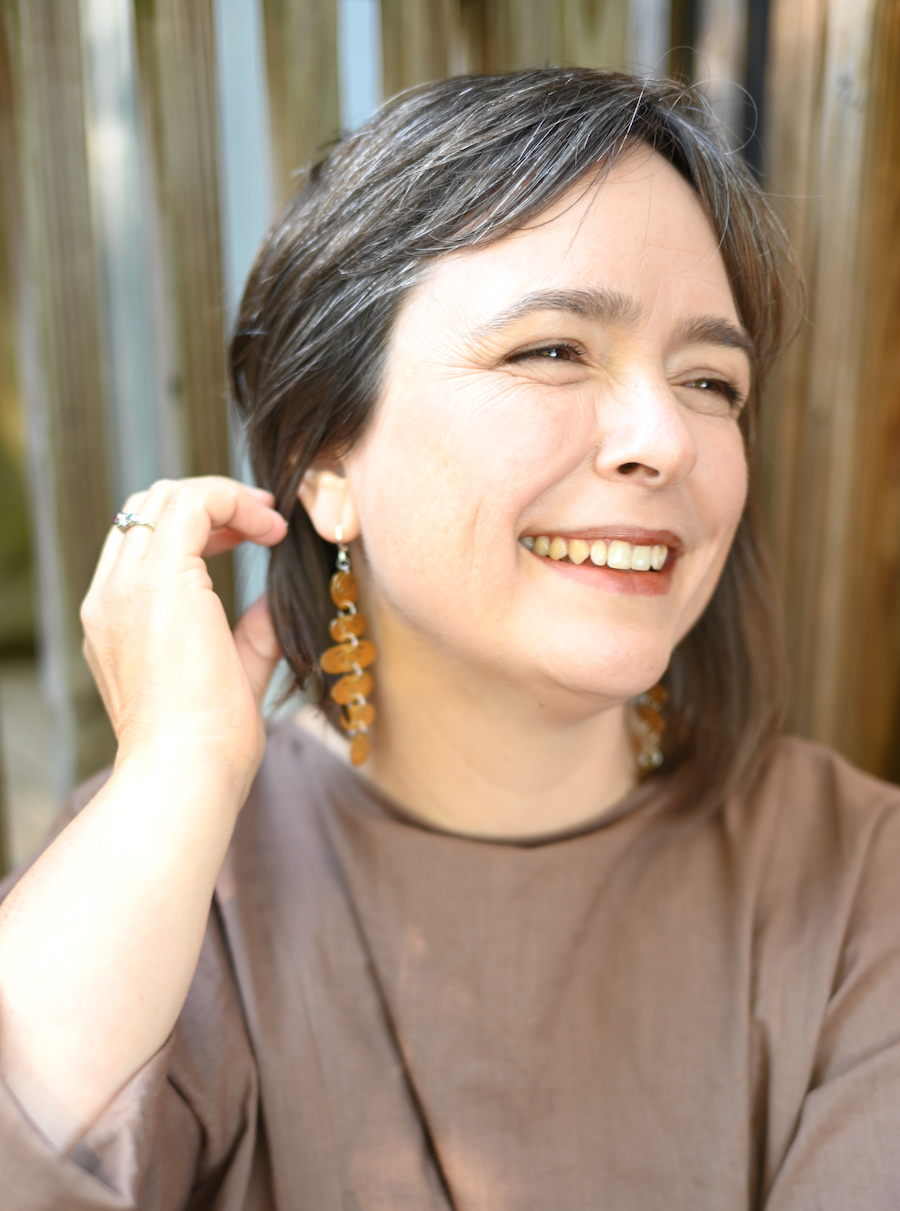
Anna Lena Phillips Bell’s second book of poetry, Might Could, is exactly the grounded reality we need right now. We, meaning, anyone worried about the present or future, about those people and landscapes we love no matter our proximity. Right now, as in, on the continual brink of ecological disaster. I first met Bell at a conference five or six years ago. I recall watching her from a distance, appreciating the path she took to the yellow house on the rise a quarter mile away. Summer hadn’t quite taken hold, and she veritably floated through the meadow where no one really walked, where wild strawberries would ripen in a couple months’ time and lightning bugs, come evening, would bling their way through the dark.
Yes, of course, it was that ethereal.
I spend so long describing such a moment because sometimes we aren’t wrong in our perceptions. Bell is the kind of person to walk across the grass, and she is the kind of person I believed would have things to say I’d want to hear. I wasn’t wrong: Bell’s poems (and personhood) float across the page, unassuming and unbothered by time, even while confronting real anxieties brought by climate change and water contamination. Hers are words that hold reality in their right hand and possibility in the other, and they contain in them an earned and practiced groundedness that meets the reader as deeply kind–to the self and her surroundings.
In this interview we delved into relationship and community—the wisdom of self and one’s quotidian surroundings, the connection we have to place beyond consumeristic choice, and what it means to live—and live well, and responsibly—in communion with the human and extra-human world. That communion here is deliberate, even if it also seems floating. We talked about the world around these poems, polluted and grounds for departure, and how in the midst still grows a cornucopia of wild things, including flowers and humans.
I was delighted to exchange questions and responses with Bell over email.
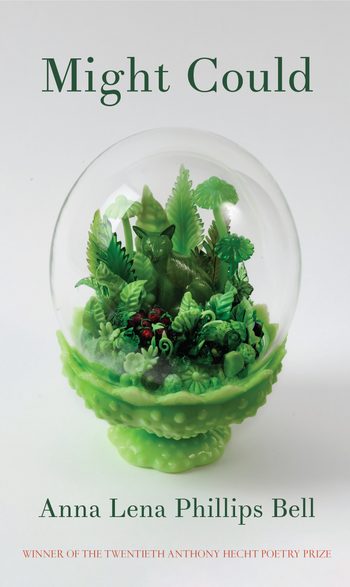
The Rumpus: Let’s start with the title: Might Could—and a good handful of titles in this collection—are often short, clipped, and gloriously adjacent to the body of the poems. How did you come to this specific title, this very Southern use of the double modal?
Anna Lena Phillips Bell: I’ve always loved the phrase might could—it’s very much part of the vernacular I grew up speaking and hearing. There’s both a sense of hope and a sense of resignation in it. When I was writing what became the book’s title poem, it just felt right. It leans toward the future, a future in which something could be almost inevitable but also feel quite uncertain. Optimism and a sort of hedgedness.
Of the two notes, I think the hopeful one has a little more power—kind of opposite to the way the phrase scans, as a spondee with a full stress on the first syllable and a half-stress on the second. The might gets more weight when you say it, but the whole phrase is nodding toward the could.
When it came to titling the whole book, the double modal felt apt for the same reasons. It’s painful to be in a state of unknowing over a long period of time, which is exactly what trying to have a kid can be like. That’s the biggest might could of this book, whether the speaker (who, yeah, is me) is going to be able to conceive a child. There are others too: whether the speaker is going to be able to make a life that has beauty and satisfaction in it while knowing about the industrial pollution that pervades the water and soil where they are. Whether they’re going to pay attention to their intuition, to the thing bigger than them that loves them. Are you going to do that today, pay attention? Well, I might could.
Rumpus: Your book begins with the poem “Placecard,” a hat-tip to your usual ability to take everyday nothings and find portals to universal truths. That first poem shows this is a poet who knows words, music, craft, AND has done the inner work that raises the vocation of “Poet” to meet the other spiritual vocations of prophet and priest. Can you speak to the process of your poems finding that wise center, and how it relates to your own experience of wisdom and insight?
Bell: Oh, thank you! Sometimes a poem shows up as a message from my wiser self. The poem “Against Narrative” came to me on a visit to Meher Baba’s samadhi (tomb-shrine) in Ahmednagar, India. But that kind is pretty rare. More often it’s just plain me, trying to record something I’ve figured out—to set down a hard-won truth so I can keep it in mind and heart. And a lot of the time I’m just trying to be with something I love or am troubled by, to be present in a real way.
Rumpus: That presence is so evident. Word on the literary street is that poems about flowers are hard to take seriously, or, a serious poet won’t choose to be present with such frivolities. Your whole book upends that belief. What would you tell a new poet who is concerned about such “appropriate” topics?
Bell: One thing to say is that flowers make this world and our living in it possible. That should be enough to make their poem-worthiness clear. Another thing is that they and their ability to do that are under threat—and we know that that threat, of greed and indifference and worse, is another aspect of the same thing that threatens the lives of people, especially people from nonmajority communities, in the US and Gaza and Iran and and and. So I reckon paying attention to flowers, celebrating with them, loving them, mourning them—in a poem or in another part of life—is entirely appropriate. And for me, it’s essential.
The plant world has been a huge part of my life since I was a kid in the rural piedmont of what’s now called South Carolina. What flowers say helps my poems to say what they say. If you’re making a poem that listens, really listens, to a flower—especially a wild or weedy flower, but even a grocery-store flower grown on another continent by a corporation that doesn’t treat people or the land right—if the poem is really listening to that flower, its scent and form and presence, it will have some depth to it. The flower might have something to say about the conditions in which it was grown—so about us—and either way, it will have its essential flowerness to share.
In fact, this book jumped the line; I’ve been working for a while on another manuscript that’s written entirely with and in support of the plant world. When I realized how strongly that world was calling me, I did worry about this a little—that it would seem frivolous. So I asked myself if that was true, and I made a bunch of poems, and I found that it was not true. This was a useful thing to do. I also keep asking myself what else of the world I need to let into my heart and mind and poems. If your intuition says something is important to write about, even if it’s something that’s not seen as serious or weighty, it’s your job to honor that.
Rumpus: Same goes with other subjects you’ve plucked out of your surroundings. There are two list poems. There are poems on the pencil, spider, firefly, vase, hat, and menstrual cup. Is this a practice of yours? Choose an object and stay with it? How did you arrive at a stack of poems so seemingly object-oriented?
Bell: It was an accident! Well, partly. I was working with a young poet during the pandemic as part of the NC Poetry Society’s Gilbert-Chappell Distinguished Poet program, and we were doing some writing together over Zoom. There we were, each in our own houses, so I gave us the prompt to write a poem for an object in the room. I wrote “Scissors” that day, which was one of the first of those poems. The same way objects themselves tend to do, the poems proliferated. I wanted to think with the tools that humans make and use, especially the ones we tend to use often, and especially ones that were invented before petroleum-based plastics became a thing.
Then, I am a little obsessed with lists. There’s a to-do list poem in my first book too. And as for the firefly and the spider, they announced themselves—the former among the pine trees across the street from my house, the latter when I was at a residency at Marble House Project—and I was lucky to be in the vicinity and then to write about them.
Rumpus: The underside of these poems is that by the time your language runs over them they are absolutely not only about the object.
Bell: I’m glad you say that. My favorite object poems—like Charles Simic’s “Stone”—are like that, and I’ve tried to think really deeply about each of the objects I’ve chosen. The series is partly about making a life that feels real, by which I mean less mediated by capitalism and consumer culture, though of course, like plastic, those things are hard to truly get away from. And it’s about the human bodies that use those tools—what an object reveals about the body and mind that are holding it.
Rumpus: And you have obviously thought deeply about both those objects and subjects. This connects to how you return to, early in the collection, wisdom that every place is not for “you.” There is permission there, and we could expand the vision beyond local, but Place seems especially important to these poems—and you spend a lot of time being in a particular landscape. Can you talk a little about your relationship to the place that IS your place?
Bell: I am a person of the piedmont—I moved to the coast because of work. Given the job market, I was lucky not to have to move farther from my home landscape. But it took moving out of my new town to a more-rural spot, and staying here a while, for me to appreciate this place where I’ve landed. I’ve lived alongside this river for almost ten years now. It’s just across the street and it’s different every day. And it has been a joy to get to know the plants who live here better, their leafing out, their flowering, their scents.
At the same time, I’ve never lived so far downstream before, or in an environment so ravaged by pollution. This river basin is suffused with toxic PFAS chemicals—the Cape Fear region was one of the earliest where this kind of contamination was discovered. That is mostly thanks to a factory a hundred miles upstream, in Fayetteville, which is still releasing those chemicals into the water. It’s so bad that, in 2023, the UN’s Human Rights Council sent a letter to Chemours, the Dupont spinoff company that owns the factory, and other parties, alleging that they had caused widepsread contamination and had withheld data about it from the public. This was the first environmental crisis the council had ever looked into in the United States.
It’s eerie to know—and I do know, because we’ve tested our wellwater—that you’re living in intimacy with so many endocrine-disrupting chemicals, that they can’t be totally escaped if you want to stay, and maybe not even if you leave. The Environmental Working Group’s map of PFAS contamination in the US shows nearly ten thousand contaminated sites across the country. Then there are the hurricanes, which we know are getting worse and more frequent because of the climate crisis.
I always thought that, if I was somewhere so affected, I would move. But moving is hard. And even with these things, I love this place. Before moving here I’d never seen a groundnut vine in flower, or coral beans. Or the little-leafed vine whose names I can’t recall right now but whose flower looks either like one of Prince’s guitars or like a clitoris. There’s always something going on.
Rumpus: Thank you for that image. And this extended moment of both remembering many details of pollution, its sources and effects, and also the momentary forgetting, when anyone might have looked it up. Names and naming comes up a lot in this book (names of plants, flowers, insects, what the body is doing, among other things). How does knowing, forgetting, not knowing, and naming circulate in your awareness, in the poems and elsewhere?
Bell: It’s so human to want to know another being, and when we have a name for something we can feel like we know it. But naming is of course imperfect. It’s shorthand; it can convince us we are on more intimate terms than we actually are. And what are the sources of the names we use? Which others have been erased by settler-colonialism, by genocide?
I think it’s my job to try to know who I live alongside, and a name makes that knowing easier, even if it’s flawed or incomplete or not the first name. I love looking through guidebooks to the flora of this region. And my partner has one of the plant ID apps on his phone, and we use it sometimes and appreciate it, and his doing that means I don’t have to have it on my own phone. A name is one step, a beginning, a mnemonic device. Being-with is how we know better.
I was talking a few years back with Heidi Lynn Staples, whose poems I love, and she’d been spending time close to the birds that lived near her but was choosing not to foreground or even, sometimes, to know their names. I think this is wise. What space is opened up, for observation or companionship, when we’re not instantly labeling a creature?
Rumpus: Thank you for articulating such relationality. These poems read as incredibly relational, too, both in a human to human and being to being sense. How did relationship show up for you when you wrote these poems?
Bell: I’ve been talking about the more-than-human part of things, which is vital to this book. The final poem, “Rules for Proximity,” tries to ask an ongoing question I have about how to be in right relation with the place and the beings I love, to understand the sacrifices and compromises required for that kind of closeness. And also, in the years when my spouse and I were trying to conceive, I thought a lot about being in a body, and living alongside another person in a body, and what it means to invite a new person into this fraught and gorgeous world. That made its way into the poems too.
Rumpus: Something about the crown of sonnets, “Bref Doubles for a Late Conception,” that you have sprinkled over the book speaks to this perspective of right relationship with place and beings, in the offering, the returning, the continuance, the intimate address. Can you speak specifically to the sonnet here, and how form holds its subject in these pages, or how the subject required the form? Or anything else to bring us closer to this sequence?
Bell: The subject of that sequence—trying to have a kid, and thinking about that effort from a particular place—felt so close to me as I was making the poems that I needed something looser than a sonnet in which to write about it.
I am (forgive me) less inclined toward sonnet crowns that don’t employ meter and rhyme. It’s not just the repeating lines but the rhyme that solders the crown together. Without it you risk having the crown fall apart while you’re wearing it, which is not a look I love (and, more to the point, it makes sustained reading harder).
As often happens when I have such a preference, my own poetics required me to contradict it, or at least in part. I still wouldn’t find it very interesting to write an unrhymed, unmetered crown, but the bref double’s rhymes are fewer than the sonnet’s, and some of them can be internal rather than at line endings, so they are less noticeable. A bref double in English is also supposed to use a consistent line length, though a specific meter is not prescribed; I have wiggled around a little with this. Each poem in the crown has a baseline number of beats per line, if not syllables. But the line length varies some between and within poems, and of course each one’s opening and closing lines are influenced by the poems that come before and after it.
Rumpus: Who were you reading/witnessing while writing this book? What wider circles of community must be named here in connection?
Bell: I was thinking of Alice Oswald and her incredible river-books, and her incredible way of making clear how a poem and a river and a person and a policy are all linked up. Camille Dungy’s poems about early motherhood, and about how racism and white supremacy affect a family, a household, a heart, and how, so do plants and animals and the places we live and love. Ross Gay’s supreme admixtures of joy and the terrible. A.E. Stallings’s brilliant rhyme and meter, precision and wit. Gabrielle Calvocoressi’s delight and frankness and gender-expansiveness. I could go on! And I was reading the work of the poets I’m fortunate to think about poems with, including a group of us who were thrown together during the virtual Community of Writers poetry week in 2021, folks who have been a huge part of the making of this book: Danny Bellinger, Andy Eaton, Meta DuEwa Jones, Carling McManus, and Issam Zineh.
Rumpus: Continuing the subject of community, Might Could has a lovely foreword from Shane McCrae. He talks at length of you as “an overwhelmingly musical poet.” He goes so far as to include you in the mix with Hopkins. I echo both. As a poet who exhibits this level of consistent—and persistent—sound and rhythm, when does the formality of that music find its right or settled form for you? Is it freedom and play, or is it constriction and control? Or are those even opposed?
Bell: It’s a sweet thing to be put in the same boat as Hopkins. It’s also a sweet thing to be asked such thoughtful questions—thank you! You say it exactly—the constraints of meter, fixed form, and emergent forms make play and freedom possible for me. Every poem needs a particular kind and degree of constraint, and I love finding the answer for a given one. And I love actually using prosodic strategies, the work of making those tools available to my future self. There will always be more to try; we are not going to run out of ways to make poems. What a delight to know that.