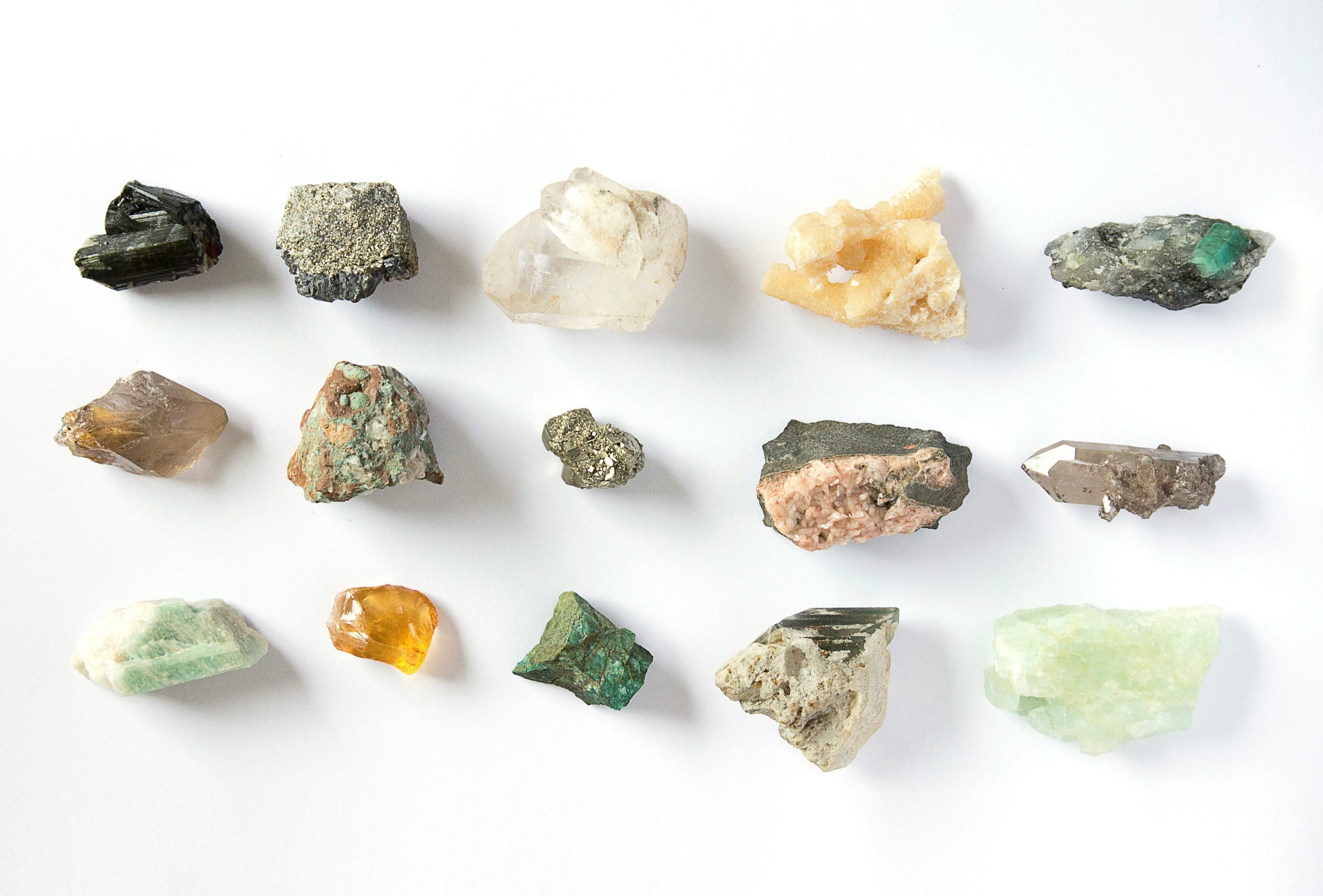
I walked around after a session, admiring some crystals Walter had resting on the surfaces of his home, which was also the office of his medical practice. He had a slew of them tucked in windowsills and behind plants: an opaque clear-white, seven or so inches long, an inch high and wide, soft corners. They might’ve been paper weights. What else? he’d say. Their long tops looked like a rippled sheet of water; their sides were marked by small divots, as if by a tiny spoon that cut glass.
This sort of careful observation was important then, both natural to me and trained.
He would often ask me What do you sense? What do you see? He told me how expensive the crystals were—worth thousands. I don’t remember why they were supposed to be worth so much, but I’m sure he said—something about how they were made in a lab, their structure more perfect than anything that could occur on its own. My mind snagged on that, the thread of me coming loose. I still thought perfect things were supposed to occur naturally, without intervention. I was maybe fourteen. I still thought Walter had chosen me as his student because of something innate in me. But perhaps the only important innateness was malleability: what sort of rock I’d be under his pressure. I would be perfect, we both knew by then, so long as I arranged all of my molecules just right, just in this man’s image.
Walter gave me one of the crystals, not on a special occasion, just a random day some months after we talked about them. The one he gave me was broken, with a crack at one thin end and a chunk missing there. That’s why I could have it; it wasn’t worth as much as the others anymore. Later—my high school graduation, I think—he gave me another. Worth thousands, he told me again. This one perfect, a symbol of the sort of healer I might become under his training.
A few months from now, we don’t yet know the exact date, Walter will sit with his lawyer, probably a cat of a man, in a Boulder County courtroom. I run through this in my head at night, unable to sleep without Walter’s face jump-scaring the dark behind my eyes. I imagine every iteration of how the trial could go.
Walter’s name will not be Walter in this room; in this room, I’ll be asked to use his real name. De-anonymize. I’ll be thirty-one, maybe thirty-two if it keeps dragging on. Walter will be in his mid-seventies. The prosecutor will open her body to the court, ask me if the doctor is present, and I’ll gesture with my hand in Walter’s direction. His crystal, the broken one, will sit in my Chinese evergreen plant at home, where it’s been for well over a decade. If I haven’t thrown it out. My mom will still have the perfect one, which she kept, in her garden, “to guide the honeybees” she says. Walter told her that something about the perfect structure is supposed to cut through the noise. She doesn’t remember what. She’ll be in the courtroom and then she won’t; she’ll start crying and—she’s a loud crier—she’ll have to leave.
“Yes,” I’ll say. “The defendant.” And then I’ll say Walter’s name.
I won’t look right at him, but I will have noted that he’s wearing a sweater over another shirt, like always. That his hairline has receded even farther in the six or so years since I’ve seen him; the depth of the widow’s peak will be gaudy, gaping. I will have told myself not to look at him at all—an act of self-preservation—but my desire to protect myself has always been smaller than my curiosity. I don’t know if this is innate or if he taught me to eschew myself in this way.
His real name will come from my mouth like a snake. Its first strike quick: soft then hard consonant. And then his family name will slither on after. It’ll come from my mouth but feel imbued entirely with his power and none of my own. The name is like the man, someone I’ve often felt I know much better than most of my family, someone who made it hard for me to know and be known by anyone else.
The district attorney will nonetheless pronounce his last name wrong for the entirety of the trial, as she did when we talked on the phone recently to prepare; she’ll soften its vowels, and I’ll hope this mistake bears no meaning to the jury. My whole purpose will be to show how his every syllable clung and clings to me, a trilobite fossilizing its shape into my stone.
For fifteen years, Walter was my teacher of the medicine he practiced and of the mind he made himself a master of: with him I studied Chinese herbs, Bach flower remedies, meridians, pulses, homeopathics, psychotherapeutic techniques.
He would draw circles on a legal pad—various “circles of self” —some crossover of Freud and Rogers and whoever else, it didn’t matter. It was the shapes, their proximity, that mattered: the idea itself and not the people who wrote it down. The circles represented things like personality, ego, emotions, physical body, mind. They were the parts of me, all gathered together on the page. They interacted closely with the world around us, getting messy and muddied. And they were ugly, mostly, or I learned to see them as ugly: he taught me to evaluate them so thoroughly as to see my growth opportunities or insufficiencies in every glance.
Amidst the sea of circles, there was always a small dot he colored in with his pen. That was the core self, or the Self. It was like a soul. Innate, untouched. That was the only part that really mattered—it was the spiritual center of someone. But he had me study all those big circles (my mind, ego, personality) instead of the little dot.
Maybe the premise is confusing, but I was not supposed to be confused, even though I was small, and he never explained in great detail. I was very smart, he said; if I gave every effort, with his help, I could be extraordinary. He drew a triangle in the corner of the paper with the circles. That was where I should live, I understood. The triangle was the observer and evaluator; that was where I could sit to watch my pieces of self. The triangle looked down at the circles and described them. This is what was important. The practice was, I suppose, a sort of depersonalization: I was exiting myself so I could view my parts from above. I was telling my doctor and teacher what uglinesses my emotions were making over in the emotions circle, what tricks my mind was playing over in the circle of the mind.
When my observations were insufficient, I remember Walter would flip the page and trace the dent of the circles and the dot and the triangle on the next page and the next, the shapes getting messier each time. Sometimes immediately after he lifted his pen from drawing them once, he’d flip a page to draw them again. For emphasis! Study, girl. I had the soft leather of the patient chair under me each time. He rested the notepad on my knee or the armrest when he stopped. Deep into pages of circles, he’d forget to carry the little dot, my core self, forward. The dot wasn’t my job to know.
To look away from my Self’s disappearance and the pace of the pen, I’d watch his mustache move and sit on my gnawed-down fingernails. He never forgot the triangle. He drew a darker and darker triangle in the corner with each new page. How is your physical body distracting you from this work? How does your ego respond when someone says you’re right? What about when you’re wrong? he asked my triangle.
I assessed my soft circles and confessed their weaknesses.
All of this was so I could treat patients one day like he did, he said. So together we could come to know how selfhood is constructed of parts. Specifically, though, how my selfhood was constructed. Its parts.
When he stopped on a page, he tapped my triangle, then my ego circle.
What do you see? he’d ask.
A shudder, I’d say. A small girl curled up in a cave, I’d tell him. Hiding.
Ahhh, he’d say, smiling.
The year I was in 4th grade, my teachers at school were Gay and Joe, who we kids called by first name. I imagine every girl who spent extensive time in Walter’s home went to the type of school where kids called teachers by their first names. Lise and Gisela, two of the women who brought the case against Walter as adults, spent their childhoods in alternative schools, one with emphasis on creative play, and one on science and art. I went to a ‘gifted’ school on the campus of the University of Denver; there were twenty-two kids in my grade for ten years. It doesn’t feel hard to guess the sorts of places Walter’s other girls, girls apprenticed to Walter, went to school or grew up, though for Davina, who came after me, and Rachel, years before, I don’t know for sure. We criss-crossed among a spiritual community Walter encouraged us to join, in which he was a respected member. My mom and moms of some other girls were members or became members.
If you were looking for a pattern in our girlhoods, it would be fair to call us sheltered, curious, stubborn, insatiable, bright. Of those, it feels imperative to me to sort which were part of our constitutions from the beginning and which were seeded and nurtured by our environments. Imperative because my biggest question now, in these months leading up to the trial is: What of me is my own and what was instilled by this man? Then: If I excavate from my body his influence, what, if anything, will remain?
Though it doesn’t seem important to the investigators or to the case, my question of what is natural—constitutional—to a person, was important to the homeopathic medicine we girls each studied alone with Walter. Though Walter didn’t care to share the human history of the medicine (viewing it as sort of divinely wrought), constitutional theory was present in homeopathy’s beginnings with the German Dr. Samuel Hahnemann at the turn of the 19th century, and it depends on being able to deduce a patient’s core self. Their dot.
I study this history now in an attempt to wrap my understanding around the harm that can be wrought by a misuse of a type of medicine that invites a male doctor to teach young girls exactly who they are, at their base. In constitutional theory, there is a specific remedy suited to each individual, a lifelong remedy that can always treat a person’s base self—bring them back into balance with who they are. While someone may experience a slew of afflictions requiring acute treatment in a lifetime, the constitutional remedy is the one matched to the core of that person; it’s the one that returns a person to alignment when they’ve gotten far from their Self.
Homeopathic medicine depends upon the Principle of Similars, the idea that ‘like cures like,’ as demonstrated by much of Traditional Chinese Medicine for hundreds of years and by Edward Jenner, who inspired Dr. Hahnemann in his creation of the smallpox vaccine from a small amount of cowpox. If someone’s constitutional remedy is made from sulphur, that person is like sulphur. If nettle, like nettle. Doctors of homeopathy have reference books with thousands of pages to remind them what it means to be like any given element. Some of the traits are superficially obvious: nettles are sharp, they sting. Some are much subtler, and part of our training was to observe in such a way that we could start to see these traits in the elements of the world: nettle individuals may be marked by pent up rage or an irritability that leads to impulsiveness. This makes sense when you consider how nettles sting—by injecting formic acid and histamines under our skin through hollow hairs, whose tips break off and get stuck there. Everything is literal and metaphoric: nettle people tend to flare with heat, have difficulty clearing infections, rage at the outside world and the self equally, in flashes.
Walter did not explain directly, as I am trying to do, but instead asked me to draw the rhythms I observed in plants on his notepads. Squiggles with different amplitudes and wavelengths. He asked me their traits and moods and temperatures. And then he’d sit and radiate different moods at me from his own body, asking me to describe and draw his projections. I was supposed to look for patterns, to start matching plants to human affect and heart.
Does an individual tend to be cold or hot? Phlegmy or internally dry? To have dry skin or clamminess? Does a person tend toward rage or timidity or loneliness? What is a person’s stamina, relationship to discipline, level of creativity and initiative? Is a person philic or phobic of light, sound, touch? These are questions of constitution: a blend of the core self and all of the circles around it, filtered through its truth. A constitutional remedy should be a potentized version of some element—a plant, mineral, venom—that figuratively answers these questions in the same way a person does.
Some remedies simply go by the names of their element, as sulfur does. Some, like nettle whose remedy is called Urtica urens, have more complicated names. It hardly matters; a girl can learn any name for herself. Natrum muriaticum, made from sea salt and shortened by Walter to Nat-mur—like I should consider it an old friend—was my remedy, he said. Which was to say Nat-mur was my Self.
When the DA asks me in my testimony to explain my relationship to Walter, I could say, “Starting when I was nine, Walter told me who I was and what I needed.”
Salt is complicated, hard to read, by which I mean both that the compound is difficult to understand as a student of its properties and that individuals marked by Nat-mur’s tendencies are supposed to be difficult to read. One day while we sat in his office, Walter mmmmmd as he read from one of his reference books, and then he leaned over to ask me if I find myself especially emotional, melancholic, in response to music. I agreed, which lit him up. “Nat-mur!” He was always crying out: Salt! Salt! to me. Salt, who is known for burying its feelings, who is marked by deep grief it preserves, and who eschews consolation. Salt, who is a moralist and a perfectionist, jabbing her corners at her soft selves; who is hyper-aware of her image in the world and who seeks to curate that image so she can manage how she’s perceived. Salt, who shrivels deep within herself, her surface pruned. Salt, who is lonely and inward but who wants to give beauty away.
I did not learn about constitutional theory as a theory. For every concept we investigated, I sat in Walter’s brown leather chair as our primary test case: I closed my eyes to look down at my pieces of self from my triangle, drew their rhythms in squiggles, swallowed down remedies and herbs. We tapped acupuncture needles into my points until I bloomed bruises around my joints. I learned to display my mind, my feelings, my ego, which gave Walter every tool he needed to study me and then lay claim to naming and describing the core self that lived tucked in amongst all of that somewhere. It was the godly, untouched, and innate part of me, my dot.
I may very well be salt. With that, what am I to do?
But internal, my self recognition was not. Walter told me about my dot: the most important part of anyone’s constitution and one he didn’t bother to train me to see for myself when I looked down at who I was.
I went to Walter’s house each week, and we studied. Anything at all.
Part of working with Walter, I realize now, was that he positioned himself as my teacher of whatever he could think of. After he decided to teach me botanical photography on top of our usual lessons and after we started going out on walks around Boulder or to the Botanic Gardens or to the Butterfly Pavilion with digital cameras too big for my hands, Walter showed me his photography website. Each image dove into a flower’s center. Poppies. Gladiolas. On a day when I was in the 4th grade, we had a playful sort of argument over Adobe Photoshop. I wanted to soften the edges of every flower photograph on Walter’s big computer screen. He laughed. He wanted to sharpen each, making them look ugly—like neon signs—the sharpening introducing dark spots and jaggedness. Still, I tried his way, as I was supposed to.
I went to school that week and showed the professional photography website to everyone in my class. We took laptops from the school laptop cart, and my classmates each picked a favorite flower to set as the background on the Windows home screens. When I told Walter about how much everyone had loved his flowers, he was furious. Still. Tall. He set aside his legal pad with its notes on me.
I’d stolen from him, he said.
The flowers belonged to him. He sold those pictures for money, and I’d taken them and given them to a whole room full of people for free.
I wasn’t yet ten. I didn’t understand it; Walter often told me to eschew attachment. He advocated for modesty, tucking cash from patients into bookshelves in his office like it didn’t belong to him and never retrieving it. But Walter was always twisting and contradicting faster than I could track. He was silvery, bouncing light at strange angles. I never learned Walter’s remedy; he never shared. Though maybe if I was older, I would’ve thought to guess—would’ve noticed the bars he built against my curiosity and gone around them, through the thousands of reference entries in that office and beyond my violent triangle into my own intuition, somewhere truer. But I was nine.
This day was the first I learned that Walter’s quiet rage was constitutional—he owned beauty and it was endemic to our dynamic that I would owe it to him. I would exist in a constant state of owing, and he would never make the ledger determining my debt accessible to me; he’d stow it on a high shelf, looking disappointed while I wondered how flowers could be anything but free.
The day I learned Walter was arrested, I was thirty. He was not in prison but out on his own recognizance. I imagined him at home. Remedy bottles on every surface. The inversion table he used to hold me suspended by my feet in the living room. Flower photos in frames. Photos of us girls. I’d forgotten, in my stretch of adulthood, that there were other girls, sometimes leaving when I was arriving, sometimes older, sending Walter letters I collected from his mailbox. That morning, I’d typed Walter’s name, his real name, into the search bar of my laptop; it was late to still be in bed, but I was. I was writing from a slop of pillows about the illness that dogged me through years under his ostensible care and tutelage and years after I left him.
I was looking for the name of the lineage of Traditional Chinese Medicine Walter always told me he studied from its last living descendant in China—the lineage I theoretically studied under him but remember little of. He never told me the teacher’s name; it was unlikely I’d find it with Walter’s credentials on the website for his medical practice, but it seemed worth a try. A bio page is, I thought, a place that asks for name-dropping, even if he said we should never stoop to fawning over human achievement.
But his website was gone.
In its place: news link after news link with his mug shot.
Walter has been, I learned, charged with two felony counts of sexual assault of a minor by a ‘person of trust’; the news articles did not name the women, once girls, but faces from my childhood immediately flashed young and bright in my head. I felt certain of who they were: the two older girls he told me about all the time—the one whose wisdom and discipline I should aspire to and the other whose light.
And Walter’s face leapt into my mind, too, narrow and ugly. Maybe Walter was, in my moment of adult recognition, watching CBS on the small television he keeps covered in a thick piece of lace most of the time, a copper talisman on top. Maybe meditating or dumping dry lentils into the pressure cooker he always advised I cook things in. Maybe he was undressing to take a plunge in the cold pool on his back porch—three feet in diameter, three feet deep.
When I was a teenager in his home, Walter often pressured me to take cold plunges with him out in that tub, but I’ve always hated cold more than almost anything, so I tensed up, resisted. A new and helpful resistance.
Natrum muriaticum people are supposed to crave water, salt, the sea, he said. He went on and on about the benefits of the frigidity, gesturing over my head and out the window. I always sat in the leather patient chair or lay on the folded massage table when I was his student and companion, and we unfurled my body and my mind to study. He hawked in a rolling office chair, gargoyle-like with one foot planted on the seat and the other tucked underneath him in a wool sock. I had to turn almost all the way around to see outside, and even then, the window was placed too high and I always facing too much at an angle to lay my eyes on the plunging tub. Visual power with Walter was like this. In the house in Boulder where he lived when I was younger, he situated me to face directly away from the window, too. I saw and looked at what he wanted me to. Windows, anyway, were obscured by hanging plants, beaded succulents, glass faceted orbs that spewed rainbows, faded lace. Inside, it was always dark. I could only look inward. I was never allowed to see the time.
‘Person of trust’ in the felony charges describes those responsible for the safety of children: teachers, camp counselors, school nurses, therapists, babysitters, doctors. If the DA can convince the jury that Walter showed a pattern of abuse, the fact of a pattern, combined with the ‘person of trust’ classification, means Walter could spend the rest of his life in prison.
When I first learned of the charges, I didn’t know this yet. I felt like I’d never known anything in my life. I didn’t see it, but I felt my Self shrink within my body; my edges, my skin, crinkled like the static on a TV screen from far away. I didn’t move for several hours. I shook.
Natrum muriaticum individuals, says the literature, are marked by deep grief or emotional suppression; they seek solitude over sharing themselves. Their skin ripples like fingertips too long in the sea as they draw inward, away from the surface. When I sat in Walter’s patient chair, he asked about my dryness, my moodiness, if I jumped at loud noises. He nodded and closed his eyes. He thrust his arms at me in a shock of movement to see if I’d flinch. Nat-murs flinch. He tossed Nat-mur, the remedy, under my tongue: tossed me into my body.
The articles about Walter’s arrest reported that the two women came forward decades after the alleged abuse because only recently did they become close, sharing their stories with each other for the first time. Finally, they realized they were not singular—somehow, he’d managed to teach us, better than anything else, that we were singular.
Indeed, I put the two of them, ten and twelve years older than I am and long his students, out of my mind when Walter told my mom and me, age nine, that I was the first child he’d ever agreed to train. There was something special about me, he said—he’d wanted to refuse my curiosity about alternative medicine, but spiritual guidance from the Higher Power encouraged him to say yes to my question. Yes, he’d teach me.
Walter and my mom, and Lise and Gisela, and others I started to remember from his house, like Rachel, and later Davina, too, and her mom, were members of the small spiritual community whose leader, Walter often reminded me, he knew well and served closely. I was too young to be a member.
Their Higher Power was the same, a god they called The Master. A right-hand man to The Master introduced my mom and me to Walter, his dear friend, who we trusted from hello.
Yes, he’d teach me, Walter said, and my mom’s face and mine, I’m sure, broke into elation.
We hung there, in the puppet theater of his world, and we didn’t notice the ground had fallen from beneath our feet. I forgot Lise and Gisela and Rachel and other names I still can’t remember, even though perhaps one of them was even in his house with us then, cleaning his thousands of glass bottles of remedies on the floor. Every girl turned crystal-like in that house, but phantomlike too. The shafts of light from among those plant-covered windows could illuminate us just for a moment from outside. All other times, we were only visible from deep within.
I was Walter’s student and his patient or plaything from ages nine to twenty-four. It would be a reasonable guess to say that for much of that time, I saw Walter every week for many hours at a time, sometimes more often, though I don’t have records of the drives to his house with my mom, who thought of Walter as The Master’s great gift to me and left me with him, or later my trips up the highway on my own. When I went to college, he and I talked on the phone, and I spent long evenings with him when I came home.
Walter traded his teachings for money or for domestic labor, though he strongly preferred the latter because it kept us in the house, most often cooking or cleaning. On the phone, when I ask Rachel, who is forty-one, if she’s yet gotten out from under Walter—if she’s been able to separate her constitution from all that he inflicted upon her—she says, “Mostly.”
She says, “I still have things about money.”
And then she says, “I mean that I paid him to abuse me.”
She laughs because what else can we do?
Rachel is between Lise and Gisela in age, eleven years my senior. Now friends with the other two, Rachel, together with them, brought the allegations of sexual assault to the Boulder County Police Department, though the news articles made no mention of a third girl. Together, the three waited a year for a detective to follow up, and then they began the many-years-long process, with the detective, of capturing memory. Eventually, the court set a trial date: two weeks before I learned of the case’s existence.
There is no statute of limitations for child sexual abuse by someone designated a ‘person of trust’ in Colorado. But Rachel was nineteen when she met Walter—legally an adult. Years after reporting to the police with the other two women, making statements, and enduring the gathering of her memories as evidence, Rachel learned she was beyond the statute of limitations for adult sexual assault and could not be named a victim on the case. Gisela told me this, when I got her on the phone the day I read about the charges after scouring everywhere I could think of for a good number for either her or Lise. Once their faces came into my head, I couldn’t get them out. Maybe I was salt, lonely and internal, but maybe I didn’t have to be. I couldn’t tell Gisela in the messages I left on her work phone why I was calling; I didn’t know. I did not have a concrete understanding of what happened to me.
That day, what I had was this: an unmediated presence that now feels invigorating. For the first time I could remember, I was all the circles with no triangle.
Gisela said she was sorry she hadn’t remembered me enough to send the detectives my way when it all started, though of course it was key to Walter’s manipulation that we not recall each other, even as we slipped by each other in the rooms of his house and world. Gisela was ethereal, fictional, to me. We’d certainly never spoken on the phone. She couldn’t talk about details of the case or her experiences, she said—it wasn’t allowed. But Rachel could. And the trial hadn’t started yet; it had been delayed for several months because of an appeal.
A week before I learned of the arrest and the trial, I picked up a plastic bin of old photos and school papers at my mom’s. She was cleaning out the garage. I hadn’t thought of Lise or Gisela in many years—angelic and phantomlike older girls I admired from childhood; sometimes one of them answered the door at Walter’s with a spray bottle and rag in hand; once, with Lise, he and I ate dahl and fish, and he sparred with the two of us at once.
I was glad to be thinking of Walter less.
In the bin, I found a photo of myself holding a camera. I must be ten or eleven in the shot—I’m wearing the onyx necklace my mom gave me for my tenth birthday, a black dot at my collarbone, which I didn’t take off for years, feeling protected by its constancy. A black t-shirt, gapped lips that are the beginning of a smile. Puberty hasn’t glanced at me yet. My eyes are wild, looking straight, in that instant, into the camera. Just behind the portrait of me in the bin was the dahlia photo I took with Walter the same day, angled just like he did his flowers, as if a triangle is nosing its way in. He’d coached me on how to edit the dahlia on his computer, and I printed it there in his office, retaining as much of its softness at the edges as he’d allow—but turned ugly, purple-sharp at its center. The photos were the size of a full page, and I set them to the side from my spot on the rug of my home office: much more natural light than his space had, and color.
I pulled from the plastic bin an old card from Lise. Happy birthday little sister! it said, with glitter. Love you so much. I smiled before I tossed the card in the trash, a nice memory of someone I’d probably never see again and never miss—someone like an old babysitter or a friend’s radiant big sibling. The dahlia went with her. The photo of me, though, I tucked into a folder to keep. Because it captured some part of my essence, I still thought. Untouched, maybe.
But now I fear it just reflected back whatever Walter drew or planted there. That I was just one of his flowers to own.
For years, Walter objected to my going to graduate school for writing instead of continuing to walk his path. I’d be a threat, I now see, if I could tell this story. The last time he and I spoke, I was in my mid-twenties, early in my MFA program in Idaho—it wasn’t some explosive ending but a falling away. I didn’t know this at the time, but by then, Rachel, Lise, and Gisela had reported him to police and to the Department of Regulatory Agencies. He’d given up his license to practice therapy and medicine rather than fight the allegations.
I did write about Walter for the first time while I was in Idaho. I tried to capture the complication of mind-control, I suppose, while taunting my audience with my own unwillingness, yet, to call what Walter did to me harm. I wouldn’t let my peers read me. I adopted his detached neutrality, reeling a reader back again and again from the assumptions I knew they’d make; I was a triangle jabbing its corners.
“Walter never touched me, would never,” I wrote. I was sure as salt.
But the second I saw the news about his arrest, I dissolved.
On the phone that night, Gisela stopped herself before she’d say much of anything.
“We have to be careful,” she said, and her ‘we’ meant the women involved in the case.
“Because he’s so beloved in the community.”
I imagined they’d been threatened—Walter’s power extending quietly and far beyond his edges, as ever. My fear of him after learning of the case was immense. I could find nowhere in my mind far enough from his reach.
Gisela waited.
“I do not find him beloved.” The words came from somewhere core to me. “I’m calling because I was harmed.”
And in saying it, I found something awful and true.
“Objection.” I imagine Walter’s lawyer will say from the courtroom where Lise and Gisela are no longer sitting on a wooden bench because they’ve been asked to leave. We won’t be allowed to listen to each other’s testimonies, lest our words influence each other’s stories.
The jury has to hear the similarities, untainted.
Right after I learned about the charges, I talked to Lise and Gisela each once. But for the sanctity of the trial, the DA advised me not to talk to them again until the case is closed.
“Speculation,” the lawyer will say because I’ll have said what Walter wanted: to define our constitutions. To grow us in his lab. I’ll have said Walter had to groom our mothers as much as us girls. So he could take us from those who made us first and remake us himself.
Rachel will be in the room. Maybe her parents. Maybe Lise’s mother, maybe Gisela’s parents. This time, my mom will still be there, hearing the full story for the first time. I’ll have asked her please not to cry. I fear that Davina, who came after me, and her mother will sit with Walter’s supporters, still tethered by what some of us have been lucky to escape. I fear their faces will look like triangles, wearing that practiced placidity of separation and study, a cross between pity and a reaction to a bad smell. Walter taught me to compete with Davina, and I learned well from him that her triangle is better, more evolved, than mine. I fear that he taught me so effectively to hate myself and hate her for it, that I’ll lack compassion for the likeliness that she’s trapped, as I was, when I see her there.
“Speculation,” the lawyer will say, and I’ll be silent.
At night, these months, when waking nightmares of the trial keep me from sleeping, my brain tries out everything the DA might ask me and every way Walter’s lawyer might take my words from me and tell me I mean something else.
On the phone, the DA tells me it’s not really like on TV.
“They can’t just tear you down,” she says. “There are limits.”
She tells me about all of the tools we’ll have at our disposal. The expert witness on psychological control! she emphasizes. She doesn’t seem to understand that this lawyer has Walter, an expert in psychological control. Walter, who knows or created or defined everything about me and all of us, as far as I can tell.
Not long after I finished college, I strapped my mattress to the roof of my Subaru and drove back to Colorado to study seriously with Walter. He wanted me to take over his practice, he said. He wanted me to move into his suburban home.
When I was in high school, he wanted to move to Nicaragua and said I should come along.
“The people are so beautiful. So heartful,” he mooned, again and again, perhaps because he loved to see me cringe and loved more the arguments that would follow: jousting at me about “political correctness” —the sheer unenlightened humanness of it, he said—was one of his favorite things to do as I got older.
He had a photo of a Nicaraguan child printed and framed in his home, a girl he’d met in the street there. Maybe eight years old and glowing, she laughed in the frame. Walter cherished and desecrated laughter, laughing as a response to any question I lobbed his way. Laughter was pure manna, he thought, pure spirituality. He loved when I laughed. But in his mouth it was a cruel sound; it came from a place of brutal neutrality, a patronizing place only a man like him can laugh from. He’d said Nicaragua wasn’t yet condemned by wealth, by ownership, those ugly things. But he also always tried to impress me by saying which celebrities and millionaires or billionaires sought him for treatment, which flew him places in their private jets.
Aren’t we supposed to be detached from money?
He laughed. I was sixteen or seventeen when I tried hypocrite to label him. It sloughed right off. It’s just paper, he said; money didn’t matter to him. His books had page after page marked by twenties.
I was eighteen, then nineteen, trying out language I learned in the co-op where I lived as an undergraduate. He was in his sixties. Fetishize, I tried. Objectify. He laughed, thrilled, it seemed, by my new sharpness. He’d changed his mind about where he wanted to move, anyway. Nicaragua was overrun by tourists, getting dirty, he said. We’ll build in Mexico, he said. An untouched beach. We sat in his living room. He’d hired a real estate agent to find a piece of land.
“Untouched,” he said again. At dinner, he’d scrolled the eco-friendly building materials we’d use, flashing his phone screen my way.
“Top of the line.”
I bit my nail. Untouched crawled over me.
Rachel and I agree now that Walter goaded us to challenge him, so he could laugh. Put us in our place.
The Nicaraguan girl hung, her eyes bright and brown above my head. Walter laughed, said “Oh” and my name. Walter was always telling me my name. Crooning and reaching across the rug to touch me on the leg. Oh, brooding Nat-mur child. Oh, laughter. Nat-mur individuals are hard to know, hard to connect to, I learned, but not for him. He made me. Even my questions were part of his equation; he set himself up to talk me out of them, convincing me of the quaintness and inferiority of my vantage and resetting me at a new angle. My questions were comically human, his laughter said. If only, when only, I stepped up to the spiritual level he was on. He knew I could. He showed me our composite astrological charts, our joint purpose. Delighted mischief. Healing. Laughter.
If only laughter.
But I did not help Walter design his heaven on the beach in Mexico. I applied to school for writing instead, wanting to touch my own story. I did not move into his suburban home.
As I understand it, he managed to convince Davina to do so instead.
Deep on Facebook, right after I learned of the charges, I found a photo of Lise, candid and breaking into the beginnings of a smile. Her curls run a little loose like always. She looks straight into the camera. She looks just like me. I know this picture right away because I’ve seen it in his house.
I looked for Davina online, too. On her Instagram account, I found flower after flower photo that looked just like mine, and I knew who gave her the lens. I found a portrait of her close-lipped and beaming, looking to the man behind the camera for a laugh. Gisela told me it seems Davina may still be loyal to Walter. I imagine her stuck in a frame on his wall, too.
It was looking at the others as girls in his photos that fully snapped something in me. Here were perfect mirrors of the girl Walter instilled in us all. In Lise’s blue-green eyes, in that animal look of prey frozen in place, that untouched fantasy that so drew the man who ran our childhoods, I understood for sure that something horrible happened to me.
After I learned of the charges, I reached out to the lead detective. I didn’t know what I thought I could offer, but I found myself desperate to be seen.
On the phone with the detective, I tried to explain fifteen years that never ended because I am still stuck in the self crafted by those years and don’t know who will be left in me if I can ever get them out. I told her about unfolding the massage table, about the remedies, intellectual jousting, the rules about what to eat, what fabrics to wear, what temperature of water to drink. I told her the rules about phone calls, texts, email, voice memos. The hours he had me chauffeur him places while he pointed out what he called the porosity of my energy field. While he tested me, again! To try to guard against his breaches of my psyche, again! While he made me veer on the road. I told her I flinch from touch, loud noises, bright lights.
Did he sexually assault me? she asked.
I don’t know.
It’s the question anyone would have. I don’t know.
Either way, she said, it will be useful to have me testify to his pattern of grooming.
I’m filled with blackouts, I told the detective. He taught me what to see, what not to see.
How could I explain the harm?
In the end, I told her how very many memories end with all of the circles of me blinking out, a sharp triangle left to scrutinize a girl disappeared.