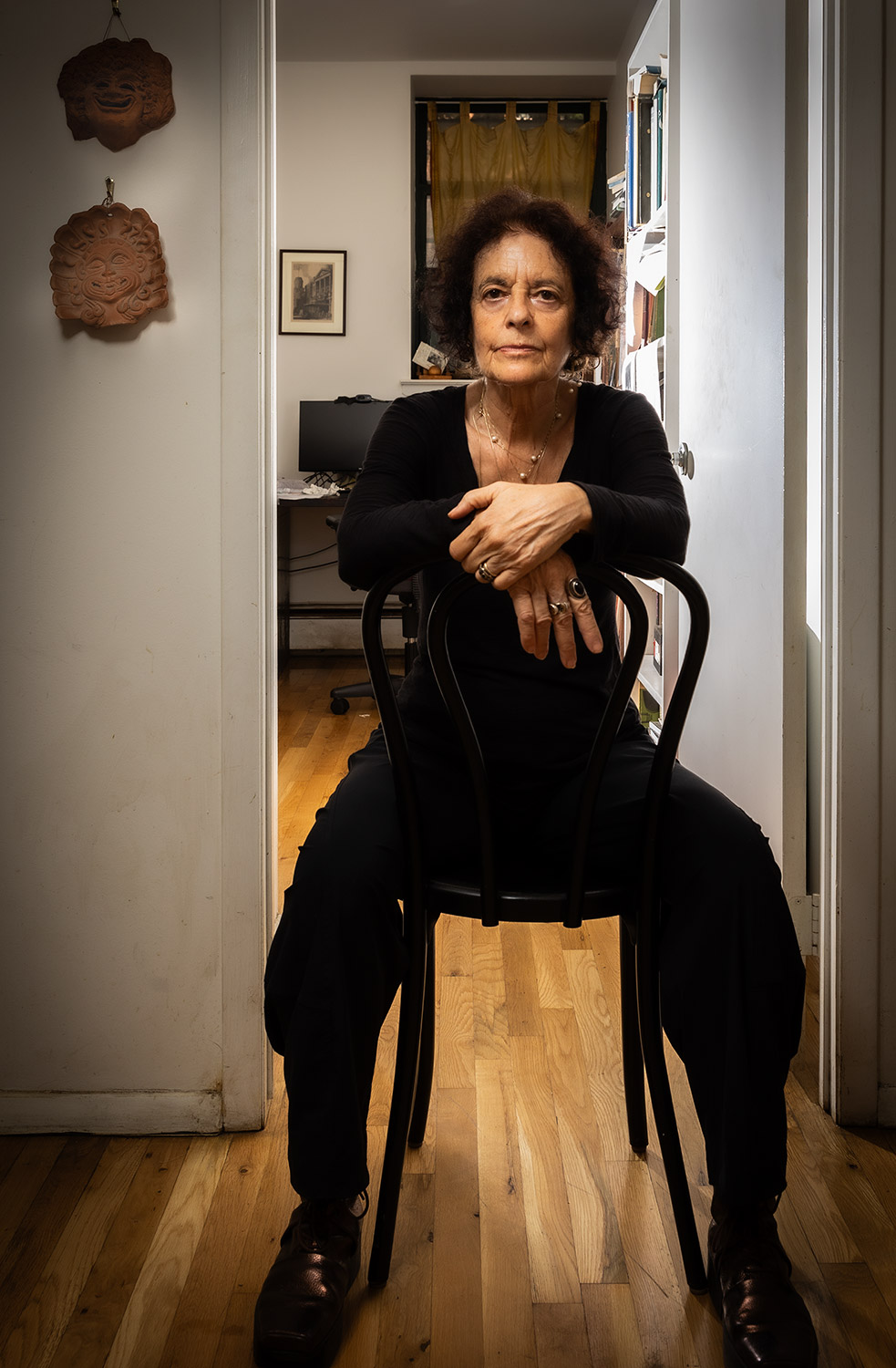
Karen Malpede and I first met and worked together in the resistance against the war in Iraq at the turn of the millennium. Then we began to work as colleagues in the theater. I’ve performed in three of Karen’s plays, and in two of them I had the great good fortune to work with George Bartenieff, a giant of the American theater. Karen, too, is a major force in American theatrical writing. Each of the three plays I worked on, Prophecy, Dinner During Yemen, and Blue Valiant, investigates trauma, but of different kinds. Prophecy looks at the psychic and physical pain caused by war and the way that pain knits all wars together. Dinner During Yemen considers how ordinary life goes on in the face of horror and the defenses we all employ to protect ourselves. Finally, Blue Valiant depicts the healing power of the relationship between animals and humans.
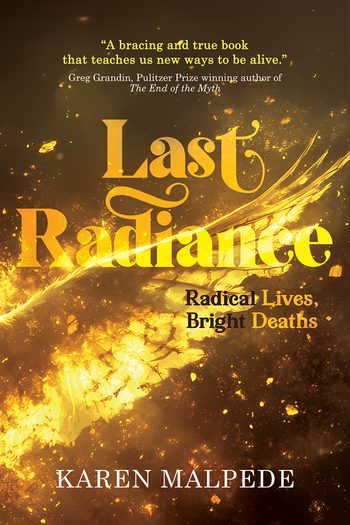
All of these plays, indeed all of Karen’s plays, are about healing, either personal, political, or ecological. There is no one like her and certainly no one more deeply committed to using the theater to save us all from destruction, both physical and spiritual. Her memoir, Last Radiance: Radical Lives Bright Deaths, complements her theatrical writing, as it both illuminates and extends her search for radical empathy. Karen’s sometimes shockingly vivid lyricism and language are a joy for any actor, and both those qualities are evident in the book. In her new play, Epstein Oratorio or a Modern Hymn to Demeter, she works her particular magic of transformation from the horror of real events to the healing of bearing witness. I look forward to collaborating with her on this new work.
We would have spoken in person for this interview, but due to an untimely blizzard, we met over Zoom in late March to discuss love, violence, political theater, and the way grief shapes art and life.
The Rumpus: Your work often returns to themes of transformation, both personal and mythic. How does that shape your approach to writing?
Karen Malpede: I use physical images just as I use verbal imagery to transport the audience. Transformations prove change is possible. Whatever we can imagine, we might be able to become.
I had the good fortune of loving and working with one of the great transformational actors in the American theater. George Bartenieff had a fantastically malleable body and a magnificent multivalent voice. He loved physical theater. He loved poetic language. We met when he did my play, Us, in which two actors play six characters, themselves and their parents, as lovers. George told me, “This is the play I’ve been waiting for all my life.” He was already in love with my language and the transformations that language worked. I fell in love watching him act.
The next play we did together, Better People, is a surreal farce about reproductive technologies and genetic engineering. It is strikingly relevant today, given the interest in eugenics of Jeffrey Epstein and members of “the Epstein class” like Elon Musk. Better People alternates between scenes in the laboratory of geneticists racing to sequence the human genome and their dreams. In one dream sequence, George became a talking head. He scrunched inside a wheelchair, and his disembodied head seemed to roll around on its seat while he gave quite a long speech that begins, “Just like Sam Beckett, I retain a vivid memory of my mother’s womb. I was carried, I said, with my head outside the universe.” Later, a huge beast (by master puppeteer, Basil Twist) wanders into his lab and speaks one word, “rendezvous.” They dance together. He is swallowed, and he played a love scene inside the belly of the beast. He emerged, a changed man, an ecologist. At the end of the play, George performed the ladder of evolution, metamorphosing from a praying mantis, through bird, lion, and into a man. These transformations showed the wonders of our dream-life and of the natural world.
In my 2018 dystopian/utopian play Other Than We, George turned from an elderly intellectual into an owl in full view of the audience. This was a staggering transformation. It comes after a number of others in the play, including a viscerally comic birth scene of fantastical creatures, and a scene in which George and an African physician nurse those “newbies” at their male breasts while having a philosophical discussion. No one who saw George change in full view from man to owl has ever forgotten the absolute magic he worked. It looked as though he took flight. George had recently been diagnosed with multiple myeloma, and this was our way of confronting death by literally seeming to soar above it.
A language that is strong enough to carry these rather outlandish physical changes is rhythmic, imagistic, and heightened, but not too much. It is a language that vocalizes the interior, as all poetic language does. The actors become buoyant in this process of speaking; the language actually fills them up until they appear to be deeply moved from within, and they become, in front of the audience, new and different. “Radical empathy” is how you describe what happens in my plays.
Rumpus: Can you walk us through your writing process? When you begin a piece, what comes first—voice, structure, image, or something else?
Malpede: The subject comes first without question, what needs to be said in this moment: about soldiers suffering moral injury, about a pregnant survivor of a rape camp in the former Yugoslavia, about the US torture program, about the censorship of climate science, about human and animal grief. Then come all the questions that follow. I do lots of research, and this often leads me to interview and often become friends with experts in various fields, major climate scientists, psychiatrists working with trauma, and refugees from Bosnia and Iraq. A journalist gave me testimonies from people who were tortured in Abu Ghraib prison in Iraq.
Sometime during my research, I began to hear the voice of the play. Then, I can begin to write. Another Life, my play about the US torture program, is surreal and satiric. I had to address that grim subject in a way that also shows the absurdity of cruelty.
Writing is a conversation between the conscious and the unconscious mind. As I become more aware of the voice of the play, I also drop deeper down, discovering new situations and feelings.
I was going to ride thoroughbred horses in England as an escape from an academic conference I was attending. I had not ridden in a number of years. You told me you had owned hunter-jumpers. “I’ll write you a play,” I laughed, but I did. Sifting through my memories of my childhood spent among horses became my research, and the voice of the play came from remembering how horse people talk. Blue Valiant was filmed outside on a farm just after the pandemic, and it can be seen on YouTube. It is also, in the new collection, 4 by Malpede plus an Intervention (Laertes).
Rumpus: You’ve spent much of your career as a playwright. How did your approach to language and storytelling shift when writing a memoir?
Malpede: I wrote about my father first, in the early throes of a grief so intense that all I could do was write, walk my puppy, and shriek. When I reread the pages some weeks later, I thought they were terrible. I remember lying on the couch in a fog of grief. I had lost George; had I also lost my writing voice? I got up and went back to work in a sort of a trance. When I was done, I knew I had found the voice of the book.
I wanted the writing to be intimate, raw, fierce, and rhythmic. In fact, these words have been used in reviews of the book and by readers. The book is full of sex, and of the joys of taking a principled stand with others, of spending a night in jail with Grace Paley, or talking about death with Allen Ginsberg in Julian Beck’s hospital room. I wished to take readers with me where we are all afraid to go, into deep love, and into dying. I don’t offer solutions. This is not a “how-to” book for dealing with whatever. The experiences I write about have no “solution.” Art and love remain mysteries. Death is. Grief is. I wanted to be present on the page, as I had been in life. George died in my arms at home in our bed. “What was special about George’s acting,” I asked the great puppet-master, Peter Schumann. “His immediacy. He was always there,” he answered without pause.
People say that my book is visual; they see what is happening and that it unfolds scene after scene. This is my playwriting self inside the memoirist’s voice. I wanted a prose voice that allows the reader to experience the wonder and terror, the pity and fear, I experienced during many of these scenes from my life.
George and I spent three years adapting the two volumes of Victor Klemperer’s Holocaust diary, I Will Bear Witness. Working with Klemperer’s words for three years had an effect on my writing because his writing is so good. We did not change one word of his book. Rather, we edited extensively. We created an OBIE-award-winning one-man play by editing two long books. We found the dramatic action inside Klemperer’s prose. I hope I found the dramatic action inside my memoir as well.
Rumpus: How do you think about structure differently when writing for the stage versus writing prose?
Malpede: Prose has more room to be. Prose, obviously, is not only dialogue. Plays are time-bound. The action takes place between characters. In the memoir, the voice is mine, and much of the action is interior, although I do quote from George’s diaries and from Julian’s writings, so that we hear their voices sometimes not filtered through mine. Nevertheless, I seem to have thought in scenes. How do I make this interaction between this one and that one (often me) vivid and clear? What’s Julian Beck like? What was it like to be confronted by armed men while on a women’s march? What was it like to spend glorious weeks for ten years every summer in a real 15th-century castle in Italy, owned by the same Ranieri family Mary Shelley writes about in her novel Valperga? What was it like to live with a great creative force as George was? “He wondered at life every minute,” I write. What is it like to lose such a love, to memorialize, to grieve, at least in my experience? I consciously wanted to write the forbidden—not “self-help.” I wanted to cross boundaries not usually crossed.
Rumpus: Writing into scenes that hit on deep grief—how do you write through it? In writing about George after his death, how did you decide which writings would stay private and what to bring into the memoir? Did that help you cope with the giant loss?
Malpede: I was half out of my mind much of the time while I wrote. I describe my state in the grief chapter. I was wailing. I was writing. I was walking my puppy, who was becoming a dog. I was wailing, writing, and walking all the time during this book. I still wail, write, and walk. There is no such thing as writing through grief. There is writing. There is grief. I describe my trip to the underground, which was the result of taking a hallucinogenic drug. I had to write about what I was experiencing. Again, the difference between play and memoir. I am the voice of this book. I wanted to tell all, to be as honest as I could be, not to help me cope so much as to leave a record that might help or at least be of interest to, and most of all, move other people. If I could have written through grief, that would have been nice, but, in fact, I will never be through with grief, never be free of having lost my great love. I am without George forever. At least, I could tell the stories of our last nights together, of the last time we made love, and another love scene when I found him alone, stuck on the toilet in a sea of glass, a glass had shattered on the floor. He was naked. We both were. There were red bubbles of blood on his toes. He could not get off the toilet because the glass was all over and he could not see every shard. I stop time in this scene. I go over and over how we looked, what we said, how we were. I want to share what was beautiful and horrible. I knew I was losing him, so I stopped time in order to keep him with me longer, to keep the reader there, too, as a witness. The scene is a night of broken glass, but it was not about hatred like Kristallnacht (George escaped Nazi Germany in 1939), but about a wondrous love we shared, which was breaking apart, would be broken forever by his death. None of these words is in those pages of the book. This is a reflection. I am not quoting myself. My intention was to bring the reader into this intimate space.
I had to write Last Radiance. I felt I owed it to George, and to many other remarkable people in the book who are no longer alive, Julian Beck, Barbara Deming, Grace Paley, Judith Malina, so many friends. Yet, in a way, the writing also released a well of grief. Grief is a large part of my life. Of course, there is no grief without love.
Rumpus: There’s a strong sense of rhythm and musicality in your language. How conscious are you of sound and cadence as you write?
Malpede: As conscious as I can be, but the sound and cadence intensify with rewriting, with going deeper, with having found the voice of the book or the play, or of a character inside a play. I think that rhythmic language can be a container for deep feelings, for startling confessions, or at least I hope so, and, as I said, for transformations, manifesting physically sometimes but transformations that are also deeply psychological. We come to see, in a new way. Rhythmic language carries us along on a river, as if on a journey, inside and out, going deeper, becoming different, or understanding more clearly.
The Rumpus: Your new play, Epstein Oratorio or a Modern Hymn to Demeter, was read this April. Does this work reflect or extend your approach to language and transformation in new ways? How do writers decide how to speak to something that dominates headlines as a response, and is that what you do here?
Karen Malpede: I have collided the ancient story of Demeter and Persephone with information gleaned from a deep dive into the dark and terrifying Epstein files. In my research, I descended into the underworld of sexual abuse of children, a terrible place. I dramatize mothers and daughters, and three nameless victims—all of the contemporary women characters are fiction based upon research and on my experience as the mother of a daughter. The two goddesses are from myth, and their language is a language of love between mother and daughter, and love for the earth. There is a chorus of men’s voices mouthing exactly what the men have said, their anticipation, their gratitude, their subsequent denial, their horrifying eugenics—these choruses are truly black humor. I am blessed with marvelous actors. You will read Demeter. Elizabeth Marlow, Persephone, Stella Everett, the contemporary Daughter. “This is beautiful and horrifying,” Beth said when she read the script. Exactly my intent. To create the push and pull between the criminal abuse, colluded in by so many, and the ancient story of a love so great between mother and daughter that the entire fate of the earth hinges upon their being reunited.
Many people believe this war with Iran was begun to take our minds off what is in the Epstein files.
It is tragic irony that the first victims of Donald Trump’s war were innocent girls at school. One hundred and seventy-five people, mainly girl children, were killed in the war’s first strike. Was this an accident in targeting? I have just rewritten the end of my play to reflect the horrible truth that just like in Epstein’s world, the first victims of this war were girls.
After its first reading, the producers, Evangeline Morphos and Michal Gamily, decided my play will be staged as a theatrical intervention for three or four performances in September at LaMaMa Experimental Theater Club, on East 4th Street, and live-streamed to the world. LaMaMa since its founding by Ellen Stewart in 1961, has been one of the premier theaters for innovative, new theater. The producers see my play as a theatrical intervention that will help affect the out-come of the midterm elections.
The play is poetry, but the political intention could not be clearer: Impeachment.
The Rumpus: Is all art political—why or why not?
Karen Malpede: As women and marginalized people, as people of color, disabled people, Indigenous people, trans people, Palestinians are finally recognized for the great art they have made all along, the cultural landscape has had to become more inclusive. We have had to envision the world anew. Only people who do not read literature can continue to hold to the colonial or the racist memes of the current regime. For the rest of us, reading each other has significantly changed our worldviews and our worlds.
I think James Baldwin might have said you cannot make art without love. He certainly believed that to be so. He had to love in order to write. He loved white men, and, therefore, although he hated racism and despised racists, he loved across boundaries and knew that love transcends. Loving the people you write about, loving their pain and their promise, reveling in their ability to love which is also your own, empathizing with the failure of love wherever and whenever it occurs, struggling to love even in pain and in sorrow, needing to love, remembering love, requiring a culture that values our love for one another over and above all else at all times: This is truly the real struggle—the struggle to manifest love.
The Rumpus: How do you balance wanting not to be heavy-handed in having a “message” but wanting to capture the interest of the viewer and reader?
Karen Malpede: I do not have a message. War is bad. Torture is bad. Climate change is bad. Grief is awful. Yep.
About a quarter of a century ago, my work was named “a theater of witness” by Robert Jay Lifton, the social psychiatrist who wrote about many of the themes that I also write about. A theater of witness, a memoir of witness, looks at the hard stuff and holds the sufferer in its gaze.
Rumpus: How does art-making, and especially the power of the word, speak into forwarding movements or bringing activism into art?
Malpede: An easy example is making women the drivers of the story. Another is creating men who become nurturing, who relish nurturing others. I do both these things over and over. I hope to leave a map of acts of compassion, even in the midst of violence, even in the midst of great loss. I am certainly “better” in my work than I am in my life, but that is because I can rewrite.