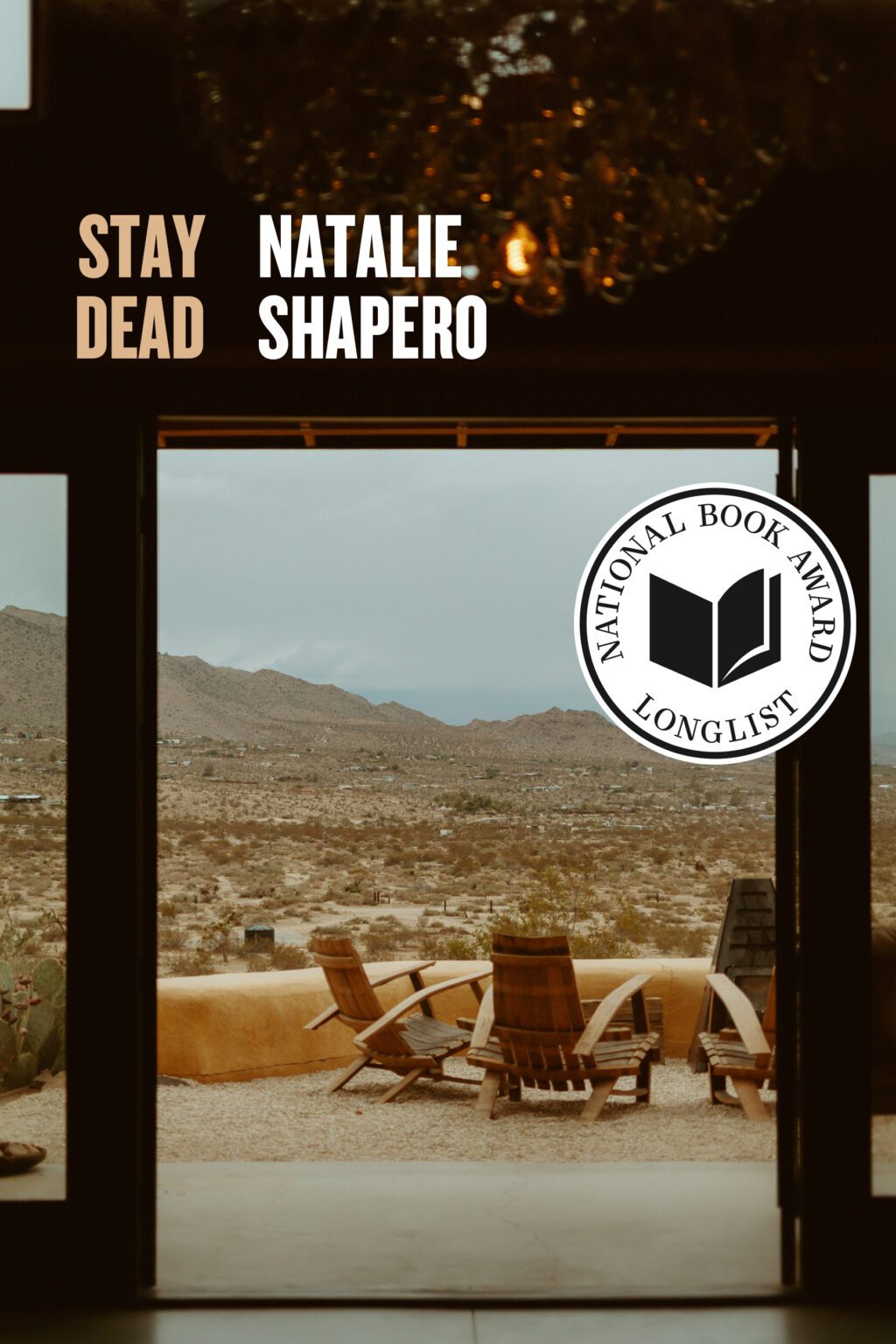
No one has died and lived to tell the tale–until Natalie Shapero. Her new poetry collection, Stay Dead, is as devastating as it is witty. As one might expect, death takes center stage. We are handed it on the first page in the form of a suicide pill for astronauts “to end it all up there if needed,” and it comes back again and again, literal and figurative, as ideation or as loss of self. Death has been an alluring muse for millennia, but Stay Dead is no derivative bouquet of odes to the Reaper. For Shapero, death is multidimensional. It is difficult to pin down and not exactly final. It is survivable not by avoiding it but by passing through it.
Death cannot be understood as separate from Shapero’s exploration of performance. Movie stars and film crews populate her world as she surveys performance as craft and its relationship to life and death. “[I] should’ve been an actor!” she writes in “Wrong Line,” as she imagines taking on the role of a painter without knowing how to mix paint.
[…] the next
thing I know, they’re plunking me down in front of an easel, watching
in exasperation as I blend carmine and crimson
not on the palette, but straight on my upturned arm, requiring
hospitalization for turpentine poisoning. When the doctor accuses me
of trying to die, I explain it was just for a role.
The collection feels more like a rehearsal than a story with a neat conclusion. We follow along as the poet pulls on threads that begin to knot with each other. How much of living is performative? What are the social and economic forces directing these performances? What do they have to do with dying? We are shown performance as a key to understanding the layers of death, which we soon begin to see as a passage that can be repeated. “Like a cat,” and like Sylvia Plath, Shapero has “nine lives. The bad news / is that this is number nine.” Death is a “liminal space / between this world / and the next,” a transition between scenes to “some next phase.” We land, then, on the performance of death itself: “I have, though, been wanting to take up / acting in order to give myself a death scene,” she writes in the final poem.
The key is the constructed landscape, going out
in front of a plywood backdrop: barbershop
or bed of rocks–it doesn’t
matter. What matters is securing
a different world to die in […]
Construction is central to performance: sets, costumes, scripts, and stage directions make up a reality that is not exactly false but that is nonetheless manufactured. A cut or a death scene marks the end of the performed reality and the beginning of a new performance. When “a single actor appears across multiple shows,” Shapero writes, “it suggests that so much / is survivable.” If we apply this to life, as the collection so often invites us to do, the end of an era (or of a “self”) is marked by a kind of death, which then ushers in the next one. In Stay Dead, we do not see the poet stay dead, but die many times over, sometimes dying “so much that after I died / I wanted to die,” or being “so dead that I overshot / death and ricocheted right back to life.”
The possibility of a final death is not lost on Shapero. She enlists an eclectic assortment of painters, actors, and public personas to help her tell her poems–many of whom (Plath, Mark Rothko, Claude Monet, Anthony Bourdain, Jean-Luc Godard) either died by suicide or attempted it. Shapero addresses them most openly in a piece about food poisoning. “Regarding suicide and its behaviors, two lines that again and again / come to mind are I ROCKED SHUT // AS A SEASHELL (Sylvia Plath) / and IT SLAMMED ME SHUT LIKE A BOOK (Anthony Bourdain),” she begins. “Except / Bourdain wasn’t writing about self-harm, his subject there was a SINGLE / BAD MUSSEL that resulted in his poisoning.” Even then, Death with a capital “D” can be microdosed. Shapero cites The Bell Jar, then returns to Bourdain:
I HAVE NO WISH TO DIE,
he wrote, but still IF YOU’RE WILLING TO RISK SOME SLIGHT
LOWER GI DISTRESS … FOR A SLICE OF PIZZA YOU JUST KNOW
HAS BEEN SITTING ON THE BOARD FOR AN HOUR OR TWO, WHY NOT
TAKE A CHANCE ON THE GOOD STUFF, and he mentioned, with admiration,
Rasputin, the reported routine of self-poisoning to accrue tolerance
Like self-poisoning, Shapero’s small deaths are bite-sized. They are meant to adapt the body while refusing to die for real. But “real,” too, is a category under scrutiny. If so many dimensions of lived experience are performed, are there any real ones at all? What does “real” even mean? The poet does not see real and unreal as separate entities. In the collection, dreams rewrite real events, the living can speak to the dead, and the concept of a “real me” is treated with irony. Acting itself sits on the cusp of these categories. Shapero advises against becoming an actor because “God observes you / violent in a scene and, thinking it is real, mistakenly / adds you to Hell.”
Of all the symbolic forces with the power to shape reality, money emerges as the most influential in the collection. Capitalism is the master puppeteer, the source and reason behind nearly every performance. On a systemic scale, media corporations–what Shapero calls the “larger papers” of “business / style metro nation real estate world” and the industries they represent–are paratexts that create and impose their dominant meaning on what counts as reality. Everyday life events, even small ones like a scratch on the hand, are read through the lens of “studios taking out / full page ads.” On a more intimate scale,wages color people’s behavior. Some things remain unsaid “because I was being paid,” and some questions remain unanswered because “I should just be thankful for the paycheck.”
In Shapero’s words, “everyone is a worker.” If many of life’s actions are performances done for payment, so that even oxygenation is “a service / the woods provide,” then art forms like acting, painting, and writing are also determined by their material conditions. In “In Something,” she describes the “sequence of conditions that gave rise to the SoHo Loft:”
The industries’ exit, the artists squatting
in the hollowed-out factories, how the sheer size
of the spaces allowed for the production of larger and larger works.
How this shifted the vogue— […]
the collectors clamoring not only for paintings of increasing
dimension, but also for the loft layouts that were ideal
for their display. The buildings acquired and sold,
the artists priced out.
Art does not rise from the magic well of beauty and theory–it is made in real spaces by real people who are often working to survive. Aesthetic trends like the one-picture wall are shaped by the economic contexts that give them life. Shapero captures this in one of the most powerful lines in the collection: “I’m sick / of producing my own subsistence / as a way to literally express my being alive.” The question of artwork is, for her, fundamentally a question of work. Shapero rails against labor as the measure of a life, as a way to prove that one even exists. She also laments having to produce her own substance (subsistence: from Latin, “substance” or “reality”) as proof of being alive–in other words, having to write herself into a legible existence.
There are many ways to produce one’s subsistence, and different art forms have different relationships to the substance they make. Acting maintains the most distance between the real and the body–if there is such a thing as reality unadulterated by performance, the performing body cannot access it. Life as performance is “a distraction,” but it also blurs the lines between real and unreal in ways that have consequences for the former: because movies are filmed out of sequence, actors “start thinking that in life / they can go ahead and die and then just be fine the next day.” The body is the bridge between the fictional and the real. Painting, instead, can capture life into an object “that must be then relinquished and hung up God-knows-where.” After it’s completed, a painting exists independent of the painter, and is subject to its own death process–being a painter, for Shapero, comes down to “being something / with the potential to have one’s work degraded by the sun.”
Finally, there is poetry. Shapero is not starry-eyed about it. She considers writing as a type of labor and even confesses to being in the “wrong line of work.” But there is something about poetry that haunts the collection, not as an exception to the institutionalization and commodification of artwork, but as a practice that fits the category uncomfortably. Unlike painting and performance, which are repeatedly linked to death in Stay Dead, poetry figures as a medium to remember the dead–to make memory of the past, and to put the postmortem pieces back together. “Watching somebody squash a bug, I’m screaming / YOU’LL NEVER KILL US ALL,” she writes. “I’ve tried to know the future, / But my specialty’s really the past. I’ve been living / For the bugs who’ve died, to remember them.” It is fitting, then, that the medium of choice to write about so much dying would be poetry. Shapero reassembles the figurative bodies of the dead after each performance, including her own. She records the wounds that remain across each death, waiting for a time when “some other bug will be living soon for me.”
Stay Dead, by Natalie Shapero. Port Townsend, WA: Copper Canyon Press, 2025.