Vampire girls are vampire girls are, I mean, vampire girls. We know one another at a glance. We are of varied genders and hail from across many lands. We curl like heat-seeking housecats around the titillating notion of the night creature, the undead rogue, the human made inhuman, but only just, the life made death made… something else. The figure of the vampire has for centuries offered a dark mirror, a human-looking monster in whom our own disorderly, painful desires are made manifest as an all-consuming hunger for blood. In the introduction to her seminal book on bloodsuckers and those who love them, Our Vampires, Ourselves, a vampire girl bible if there ever was one, the academic Nina Auerbach wrote, “Vampires are neither inhuman nor nonhuman nor all-too-human; they are simply more alive than they should be.” This uncanny proximity to the real, to us, keeps the vampire vital and compelling within the collective imagination even as other, less familiarly embodied monsters cycle in and out of style. The vampire is fertile soil in which to sow explorations of what it is to exist on the fringes of society, to be exiled and hated for what you are. Racism, sexism, homophobia – any strain of bigotry which stews to steaming in the world can easily be projected upon the vampire, and so there is catharsis in our identification with the monster, the one made abject. That this allegory can be simplistic, juvenile, even, in certain renderings, does not erase its potential as a site of pleasure, not when these melancholy killers are, first and foremost, such good fun.
Decades before Stephenie Meyer shook up high schools worldwide with her anemic, Mormon vampires and years before Buffy ever kissed Spike, Anne Rice, the spiritual godmother to each beautifully insane individual to ever post horny slash fic on AO3 and an eternally questioning cradle Catholic, created the blueprint for the soppy, sympathetic vampire who still reigns today. Rice’s vampires are men of feeling and, oh, the world is going to hear about it. They fight and flirt and cry blood tears and murder mortals all in the spare time left over after hours of navel-gazing. Through her vampires, Rice circles her own questions of faith. Is there a god? And what of heaven? What is the point of it all? Her creatures use much of their extravagant longevity to agonize over all of the above. The prose does not particularly stimulate and the plotting tends toward the inelegant. Yet, there is a vigor which shines through Rice’s work, and that vigor is enchanting. The enormity of her love for her characters is such that, upon reading, one begins to feel, first, a bit crazed, and next persuaded into the same enthusiasm, as if her passion were an infectious disease. What the novels lack in literary quality, they make up for in abounding, wonderful weirdness.
Rice writes the love between her vampires as something equally ecstatic.The men of Anne Rice’s oeuvre can, and must, be read as gay if we wish to make any sense from their journeys together and, importantly, so that we can have a good time. These vampires don’t fuck, exactly, but in AMC’s excellent recent television adaptation they do. It feels unjust that Rice, who was involved in its development before her death in 2021, did not live to see the show herself. There is no element of the sumptuous production onto which I could not heap praise, but it is a particular tragedy that Rice was never to see her Lestat brought to astounding, radiant life by the actor Sam Reid, who often seems almost to be channeling something genuinely supernatural. Rice may not have a place in the annals of fine literature, but she was and will forever be one of our most important vampire girls.
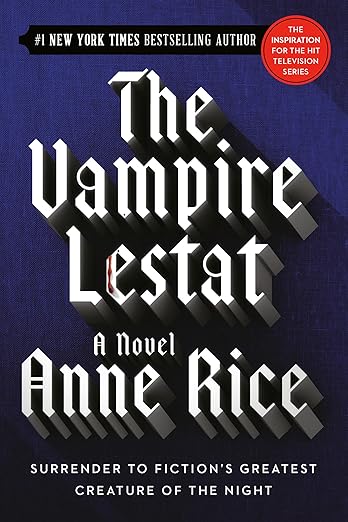
In writing Interview with the Vampire, her 1976 debut novel, Rice sought to process the death of her young daughter. The book follows moody worrier Louis de Pointe du Lac, who, in the aftermath of his brother’s death, meets a French dandy vampire named Lestat, is turned into a vampire himself, and begins to live with Lestat as partners and also to coparent the evil and depressed little girl vampire they foolishly make together. We receive the story as recounted by Louis, more than a century after the events, to an eager young journalist, and with all the corruption, unconscious and not, that memory guarantees. It is an interesting, at times plodding book about being Catholic and hating yourself, two of history’s more enduringly fruitful sources of creativity. Interview with the Vampire was the life-changing hit that spawned a deranged film starring Tom Cruise and Brad Pitt, but it is in the exuberant, globe-trotting sequel, The Vampire Lestat, a work that’s something like the Book of Genesis for homosexuals with personality disorders, that Rice truly let her freak flag fly, serving up an unbridled, meandering hagiography of her champion. This book follows Lestat de Lioncourt as he transforms from a fussy blond gay guy who weathers sporadic periods of ennui through sheer force of his own vanity to a fussy blond gay guy who does all of that stuff but also is undead. And while I have my notes on both the content and form on display across its five-hundred pages, in the end, to witness the becoming of Anne Rice’s precious Lestat is our honor indeed.
Lestat is beautiful, strong, brave, stylish and talented. Rice via Lestat, in first-person, makes this clear on almost every page. Rice writes with abounding, unavoidable affection for her often quite stupid protagonist. He is the man of action she wished she could be. In interviews she explained that Lestat is,“the person who could go through life joyfully, in spite of the doubts that torment me, the horror of death that torments me,” and that he “sprang to life in the corner of my eye.” She seems to have experienced the character as a force unto himself, and reported that writing as Lestat happened very naturally and without significant labor. Rice occasionally mentioned her husband as one inspiration for Lestat. Height and blondness, perhaps, she drew from Stan Rice, but one would be hard-pressed to name something Lestat de Lioncourt resembles less than he does anyone’s straight, American husband. Lestat was so real and alive to Rice that even the more nonsensical incidents in The Vampire Lestat possess a surprising depth of feeling.
As The Vampire Lestat is meant to be Lestat’s response to the in-universe publication of Louis’ damning interview–I know, but go with me here–the book is narrated by the Lestat of the 1980s just as he embarks on his new career as a rockstar. Of Louis, whom Lestat still loves but is ever inclined to drag, he says, “he was, after all, a discriminating and inhibited child of the middle class, aspiring as all the colonial planters to be a genuine gentleman, though he had never met one.” This does not stop him from falling into Louis’ arms by the novel’s end. We vault back in time to his mortal youth and move slowly, painstakingly forward. In true gay fashion, Lestat had an unhappy childhood surrounded by dreary people who wished always to dim whatever light he might scrounge up. An episode in which he runs off with a theater troupe and feels the first joy of his life only to be cruelly dragged home is particularly wrenching.“What sin was there, I thought, except to live out my life in this awful place?” Rice does not say that Lestat is gay. She says that he dreams of being an actor, that he cries when he thinks about witches being burned, that he is in love with and kisses and shares a bed with a violin playing boy from the village and they want to run away together. Lestat’s consumption-riddled mother proves that she’s an ally as she tells him, “I want to die knowing you are in Paris.”
Before Lestat and his Nicki make their way to the city, they get drunk and Lestat has what they would have called a panic attack if it weren’t the 1700s. “I realized aloud in the midst of saying it that even when we die we probably don’t find out the answer as to why we were ever alive.” This bout with proto-nihilism incapacitates him for days. “And let me tell you a little secret. It never did pass, really.” Lestat’s later philosophical quandaries and short fits of existential unhappiness, of which there are many, feel rather like a reheat of this blistering realization in the twilight of his childhood, and his mortal life. Lestat is no great thinker, but he is deeply sensitive, in his own, self-obsessed way. “Do you realize that? We’ll never know why the hell any of it happened, not even when it’s over.” While Lestat, the illiterate and despairing son of an impoverished 18th century nobleman, can be excused for the limited intellectual scope of his soul-searching, the way the novel repeatedly tramps across this same terrain is less forgivable. And yet, these infantile battles for understanding do move me, possibly because I too was raised Catholic, certainly because I too suspect I’ll never know “why the hell any of it happened.”
The boys hit Paris and they’re penniless and they’re hungry and they’re so, so happy. (“I was always happening upon an execution in the place de Grėve.” Fantastic.) They both take up work with a lowly theater and live together blissfully in a wretched sixth floor room. But their cheerful domesticity is not to last. Before he has passed a single year in the city, Lestat is abducted by a hideous beast, taken away to a suitably villainous tower, and drained of his blood. Having succeeded in sharing “the dark gift”, the ancient monster kills himself by fire. Lestat wakes up a vampire and thinks things like, “I wanted a great deal of very cold white wine,” and “My waste was leaving me in a small torrent.” He discovers in the tower a pile of dead young men, each of them as tall and as blond as he is, and another pile of jewels and gold and treasure. Clearly, Lestat is in the lair of an inveterate sicko, now gratefully incinerated, but at least, also, Lestat is rich. He buys elegant clothing. He buys expensive toys to send to his nieces and nephews. He buys himself a lawyer who will conduct all business at night and ask no questions. He attends operas. He attends plays. He pays for Nicki to move to a well-appointed apartment. He becomes the generous benefactor of the old theater where they so loved to perform. It is the money, more than the immortality, which most changes Lestat’s life, affording him the freedom to be a full-time Just Asking Questions guy. His god, finally, is beauty, be it in the form of a symphony, a fine velvet coat, or a hot man, and all of it is now within his reach.
So many other things happen in the book after this transformation. Lestat turns his mother into a vampire, for one, and so pleased are they to be together and free of their ugly family, they kiss each other with tongue. He meets a coven of vampires who live in seclusion and worship the devil and he basically laughs them to death. He has insane sexual tension with every male vampire he speaks to. He eventually reunites with Louis and thinks, “the love I felt for him was positively humiliating.” He travels around Europe for years on a dispassionate quest for knowledge of other vampires, of their history. He ends up in Egypt beefing with, for all intents and purposes, a mummy. Of course, he also kills a lot of people. That’s really not a big part of these books, but it does happen. All the while, he wrestles with his discontentment. All the while, he craves companionship and closeness. All the while, he laughs off strife and suckles up praise. Much of what occurs in the second half of this novel actually makes no impact whatsoever on Lestat. He is Teflon. He is The Unsinkable Lestat de Lioncourt, an ultimately comic figure far too narrowly focused on his own sensations of pleasure or displeasure to be meaningfully altered by outside happenings. He is, in short, a huge bitch, and it is a delight to watch the world through his eyes. Which, he would add, are an extremely bright blue. I do think that reading The Vampire Lestat, living with his thoughts for even a few days, absorbing, whether you wish to or not, the full force of Anne Rice’s love for him, does give you a kind of brain damage. I do think I have been chemically altered by the experience. And I do recommend it to others.
Lestat speaks to my inner vulgar dilettante, a wanting, childish self I hide whenever I am able. Yet, his manner has its power. What good are inner depths if you only drown in them? Lestat might be onto something after all. Next time you’re feeling down, consider saying, “This is ridiculous, I never despair!” Anyway, it’s what Lestat would do.