
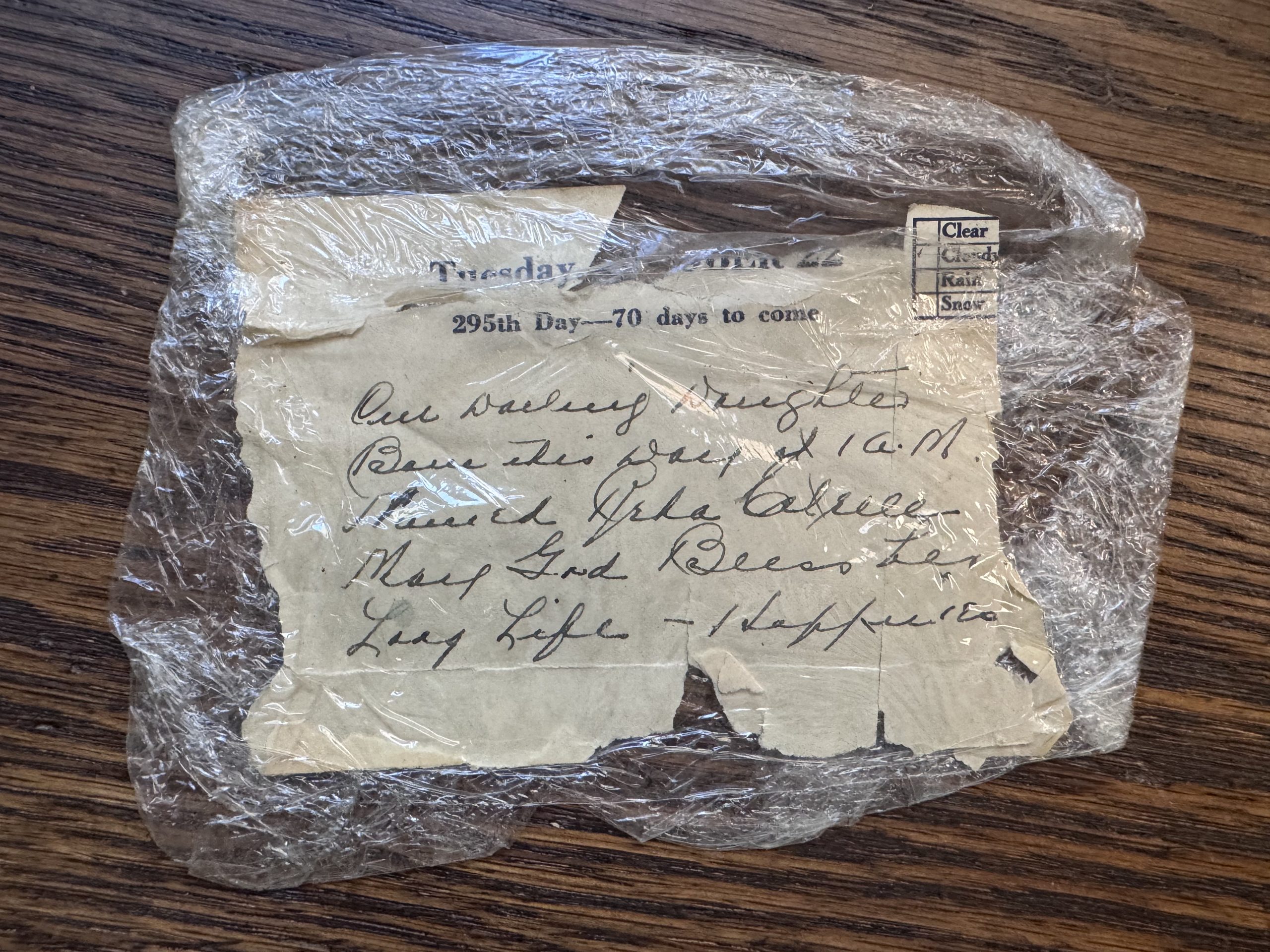
According to city records, October 22nd, 1935, was an unseasonably warm and sunny day in Brooklyn. It was a Tuesday morning, and my grandfather wrote on a piece of paper and tucked it into a tiny tan leather address book:
Our darling daughter born this day at 1 a.m.
Named Rita Estelle
May God bless her
Long Life and Happiness
Ninety years later, I found it buried deep in my mother’s desk drawer when my wife and I were emptying her apartment after her death. The note was written on a page pulled from a 1935 desk diary and then wrapped in Saran as a means of preservation; it worked, and my grandfather’s beautiful Palmer Method handwriting was also preserved, adding to the message a certain grace no one knew he possessed.
“He never loved me,” my mother would say to me one day out of nowhere, over lunch at her favorite bistro. She mumbled something about his liking the flock of homing pigeons he kept on their Brooklyn roof more than he liked her. She opened her silver compact, reapplied her lipstick, and shrugged matter-of-factly, like she was talking about a stranger; then she changed the subject.
But months after her death, I had proof that she was wrong—that she had been wrong about her father all those years—and now I couldn’t share it with her.
*
Can we ever know how well we are loved by our parents? Can we ever truly fathom it—the way they feel about us as people during our years of overlap, from our childhood and their adulthood to our adulthood and their old age? Children know when they are disliked. They can feel it. I once knew someone who freely admitted to me that she didn’t like her daughter, who was still in single digits at the time; would this child grow up knowing that she was the recipient of her mother’s animosity all her life? Would her mother’s feelings for her change? Evocations of love after one loses a parent travel through a filter of memory and unfulfilled need. Trying to discern the truth behind filial love is like looking through a kaleidoscope whose glass shards are broken; the potential for beauty is there, but some internal mechanism can’t quite click into place, and what is left is a shattered muddle. My mother loved me—I am certain of this—until I was old enough to realize that I had become an appendage; her love for me transformed as I grew into a person antithetical to her, with needs and desires that she could neither understand nor predict. When I was an adult, she told me, in fits of rage, that she had given everything up for me, and wasn’t I even aware of that?
My mother was a television singer and a model; her pragmatic father wanted her to go to college and find gainful employment. “Your grandfather refused to pay for any of my singing lessons,” she’d say, “but he offered to send me to New York University.” She repeated it like a mantra: “He wanted me to fail at what I loved.”
*
Born a year after the Depression ended to older parents who were not quite in love with each other, my mother was not an easy child in the way she was not an easy adult, prone to violent tantrums and the problems of want that haunted her like an addictive substance. Theirs was not a happy home; my chronically angry grandmother was a closeted lesbian. She was quietly involved with the same woman for sixty years—a teacher who lived in a Leroy Street apartment with, my mother recalled from a childhood visit, black walls. They were together three days a week until the mid-70s, when my grandmother made one of her subway trips from Queens down to the West Village to see her. I imagine her climbing out of the West Fourth Street station older and stiff and with bad hips, and moving more slowly than she had so many years earlier, when they were still young women. On that day, my grandmother discovered that Nora had had a stroke and no longer recognized her, and just like that, the covert relationship was suddenly over, without formal acknowledgement of either love or grief.
Seeking love elsewhere, from the ’40s until his death in 1969, my grandfather was illicitly involved with a nun called Sister Redempta from the nearby St. Vincent’s Boys’ Home, where he sponsored Italian war orphans relocated to Brooklyn after the Battle of Rome. A taciturn, unsmiling man charged with the care of his elderly mother and younger siblings, including one who would die in a Brooklyn asylum, he was not given to displays of affection, and instead took comfort in uncomplicated things: the presence of the Sister; helping the boys of St. Vincent’s; the dozens of stray dogs he took in over the years; the flock of homing pigeons that lived on his rooftop, and who, no matter how bad the world got, always came home to him. In my mother’s belongings after she died, I found a dozen canceled checks made out in his hand to Sister Redempta and St. Vincent’s, which my grandfather, a furniture store owner, outfitted with free beds and chairs and desks as the number of orphans there increased during the War. St. Vincent’s still exists, and to this day, they still say novenas for him, even though he was not a Catholic.
So my grandparents’ only child was born of a single night of requisite matrimonial mechanics. Growing up in a home without evidence of tenderness took its toll on my young mother, who instead learned about romance and affection from the movies: At five years old, she imagined herself to be Judy Traherne in Dark Victory, and Charlotte Vale, who escapes the grips of her domineering mother in Now, Voyager. She inherited my grandmother’s love of music and my grandfather’s fondness for dogs, and devoted herself to them. Buried amidst the cancelled checks to the Catholic children’s home, I found a scratched celluloid 78 of my mother on her sixth birthday, singing “How About You” in a Times Square recording booth. She sang the song twice, with perfect pitch and the vibrato of a woman four times her age. She went home that day to a new dog, and it remained her playmate and best friend for the rest of its short, urban life. Between the movies, music, and dogs, my mother cobbled together a tiny universe of peace for herself, and it was just enough to keep her moving forward, despite the haze of chronic sorrow and disappointment hovering over everything like a storm cloud. Looking through photos of her and her parents from that time, I always thought they actually existed in black and white, in a world devoid of color and warmth.
*
An October baby defined by her astrological sign of Libra, the scales, my mother was an almost-ran: She became a television singer who was almost famous, a model who almost made it into magazines, a wife who was almost happy, a stunning New Yorker who was almost wealthy, a mother who was not quite delighted with her daughter. When our relationship was at its most treacherous, the triad of October and music and dogs—my dogs—quieted her disappointment, which settled like little flecks in a shaken snow globe. She was an autumn baby, and October was an undeniably beautiful time, almost cold and almost not, when Manhattan was at its loveliest and woolens came out of closets and leaves blanketed Central Park. But it was also the month of her birthday, when celebration and the fact of her aging ran hand-in-hand, and the latter cancelled out the former; she would forever lie about her age.
Before their divorce in the ’70s, my father, whose job as an advertising creative director was floundering with the failing economy, arranged a surprise fortieth celebration for her at a now-defunct steakhouse on Manhattan’s East Side. During the drive into the city, my father played Frank Sinatra’s “It Was a Very Good Year” on our Buick 8-track, and when Frank got to the part about it being “in the autumn of the year,” my mother shut it off. We walked into the restaurant and her in-laws shouted, “Surprise!” After an initial smile and thank-yous and the opening of gifts, some with the price tags still attached, my mother sat at the table in silence, glowering at my father and her family-by-marriage as the servers floated around her. My father was well-intentioned but made one gross error by throwing her a fortieth birthday party rather than a generic one; suddenly, everyone knew her real age, and that she was no longer in her thirties. When the party was over, we drove home to Queens, my father took the dog for a walk, my mother poured herself a glass of Soave, thumbed through her albums, put on Peggy Lee singing “Is That All There Is,” and sang along with it.
*
By the time my mother was in her forties, her father had been gone for six years. An owner of several commercial and residential buildings in Williamsburg, he was collecting the rent one day, was followed, and mugged. When the emergency room X-rayed his ribs to make sure nothing was broken, they found a grapefruit-sized sarcoma in one of his lungs. His Parkinson’s made him too frail to release from the hospital, and he died after a short stay.
“The last time I saw him,” my mother told me after her first fall, when she was in the hospital, “I was sitting on his bed, feeding him, like a baby. It was the closest we ever came to love.”
I remembered this conversation a decade later, when she was in hospice and unresponsive for the last two weeks of her life; on October 22nd, 2025, her ninetieth birthday, I sat alongside her bed, held her hand, and sang her Happy Birthday. She never opened her eyes, and died on October 29th, bookending her favorite month of the year with life and death.
Is this what a certain grace is—that moment when an adult child leaps over the chasm of antipathy to finally understand the truth, even when it has never been uttered: that they might have indeed been loved despite what they felt through the filter of time and experience. Her reserved, often distant father wrote a note on October 22nd, 1935, quietly welcoming his baby girl to the universe, uncertain of it ever being found. That wasn’t the point; it was a quiet prayer to the gods to keep her safe. She would never see this proof of affection for her; I like to believe that, eventually, she knew.
Click here to subscribe today and leave your comment, or log in if you’re already a paid subscriber.