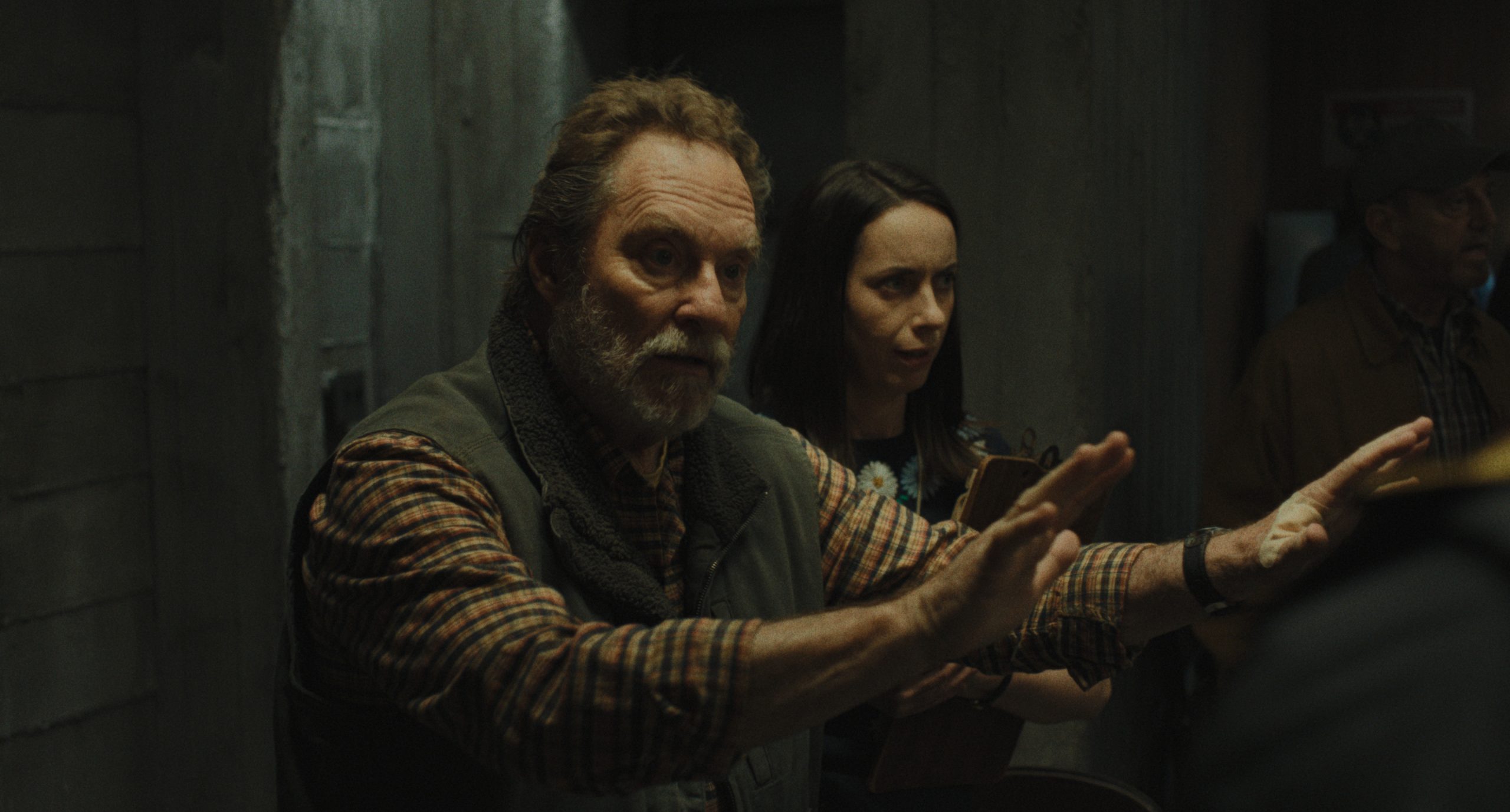
In episode 1 of Widow’s Bay, Apple TV’s latest hit series, the mayor of a remote New England island, Tom Loftis (Matthew Rhys), courts a New York Times reporter (Bashir Salahuddin) in hopes of getting a write-up that will boost tourism. But Mayor Loftis is also hiding a huge secret—the frights, curses, and zombie-filled legends in the history of this island community are, in fact, gruesomely true. And when Loftis’s own fears finally drive him into a state of panic, the Times reporter suggests he gets the message.
“I see what’s going on here,” he tells Loftis. “You don’t want to be Nantucket; you want to be Salem. It’s a nice town. You don’t need the gimmick.”
The “paper of record” is, of course, wrong on that score: Widow’s Bay is a place of great complication. And in ten episodes, this deservedly lauded show has trapped us in a world at once both familiar and foreign, with jump scares following on the heels of hilarity. Through Loftis’s eyes, we see a vacation spot we’re grateful to visit and never live in (to say nothing of being born there), with so many beautifully untied loose ends that can only lead to spine-tingling magic. And best of all, it is operating in a genre—horror-comedy—that has finally risen past cult status into the mainstream. That its writing, directing, acting, and production have earned the series nineteen nominations for the upcoming Emmy Awards is no surprise. Presumably this will earn the show some well-deserved gold, but at the Emmys, nothing is ever guaranteed.
Again and Again
The Emmys—which air on September 14th—are unique among award shows in that most of the honors given every year allow for an insane amount of repetition. From 1994 to 1998, Frasier won five straight Emmys for Outstanding Comedy Series (over, among other shows, Seinfeld, Friends, The Larry Sanders Show, and Mad About You). The feat was matched from 2010 to 2014 by Modern Family (which topped Curb Your Enthusiasm, The Office, Parks and Recreation, and The Big Bang Theory). In both instances, some of the more uniquely styled shows were shut out, since playing it safe has often been a hallmark of Academy success.
But the TV Academy has also, by slow necessity, mirrored the evolution of the industry. Traditional broadcast shows ruled the evening for decades until cable, and then pay cable, and then streaming ruined most of their fun.
HBO—and now its streamer, HBO Max—remains a major threat every year, leading all comers this time around with 122 nominations. Of those, twenty-four are for the bittersweet final season of the comedy Hacks, and twenty-five are for the sophomore season of last year’s Outstanding Drama Series winner, The Pitt. The latter is the frontrunner to repeat this year, and understandably so. It has traditional medical drama pedigree (and, of course, a great Noah Wyle), but it’s fashioned for the post-Covid era, and while it keeps some of the soap allure of, say, Grey’s Anatomy, it also had enough blood in Season 1 to make one of its ER characters pass out.
It has some great competition, including Apple TV’s magnificent first season of the post-apocalyptic dynamo Pluribus and a best-season-yet vote for Netflix’s political thriller The Diplomat. What it doesn’t have is competition from BritBox’s glorious The Other Bennet Sister or the season’s biggest culture-shifting entry, HBO Max’s fire-on-ice romance Heated Rivalry. Arcane Academy rules have banished them to international awards consideration because they were not initially US co-productions. To which I say, “I mean, come on!”
Of course, the Emmys, much like most televised award shows, are also known for other arcane rules, although these usually go unwritten. For instance, no presenters are permitted to hand out a trophy until they’ve first engaged in at least one or two minutes of such pointless, incessant patter. You would be forgiven for shouting, “I will never get this time back again!” at the television, should you choose to watch the shows live. And that other famous rule: Poignancy in acceptance speeches must be eliminated quickly (“Cue the music!”), unless delivered by a rambling, entitled star. But I digress.
The best nominees from cable and streaming are great examples of what TV has always needed and gets a bunch of in this era: chance-taking series. While commercial broadcast television remains, for the most part, formulaic, the best streaming entries go bigger and deeper. There’s a reason we were addicted to Severance, Ted Lasso, Euphoria, The Bear, Succession, Stranger Things, and The Studio; they each tapped into a need for either comforts, passions, or a view of lives that were even more outrageous than ones we were, or are, living in. Without censors or advertisers to potentially dictate the breadth of content, and without the need to worry about viewer complaints, shows on premium networks or streaming don’t need the blueprint of the weekly procedural. They can focus on story continuity and extra layers of realism.
Scare Tactics
Widow’s Bay is the favorite to take Outstanding Comedy Series this year, and if it does, it’ll be a triumph some thirty-six years in the making. That it became the most captivating binge of the summer is no surprise, since it shares a don’t-go-near-the-water bloodline with Jaws. But its true tie extends to 1990, and the series that first made it safe to explore the border between the horrific and the comedic: Twin Peaks. Like David Lynch and Mark Frost’s masterpiece, Widow’s Bay gives us a look at the chilling darkness of small-town life, the rot on the inside of the white picket fence. A tolling church bell might seem quaint and ordinary, but given that the church bell in Widow’s Bay has long been dismantled, it becomes a harbinger of evil.
Peaks remains a beloved classic, but it has never risen to the type of universal acceptance it always deserved, even if its influence is secure. (As The Sopranos creator David Chase once put it, “Anybody making one-hour dramas today who says he wasn’t influenced by David Lynch is lying.”) But what makes Widow’s Bay work so well is how it perfectly balances the chills and the laughs. Other series and films have treaded there with different levels of balance. Shaun of the Dead, Zombieland, Fargo (the movie and the subsequent series), and What We Do in the Shadows (which scored four Emmy nods for Outstanding Comedy Series) all come to mind. But none of them have you teetering the way Widow’s Bay does. When Loftis interviews the zombified remains of island founder Richard Warren (Hamish Linklater), and you sense that anything can happen, breakout star Kate O’Flynn’s entrance into the scene—“Sorry, I forgot my purse,” is her character Patricia’s astonishing excuse—becomes the stuff of comic magic. Plus, no one on earth does horror and comedy together quite like Stephen Root, who is perfection as Wyck Crawford, a walking catalog of the town’s many dreads.
If Widow’s Bay does win the Emmy, it’ll widen the audience for a genre that belongs solidly in the mainstream. But there’s actually an Emmy category Twin Peaks would be perfect for: this year’s new Legacy Award, honoring a show that has made a profound and lasting impact on culture and society. The award is a very good, long-overdue idea. (As to why it hasn’t happened before, Television Academy President and Chief Executive Maury McIntyre admitted to The Los Angeles Times, “We were idiots and didn’t think about it until now.”)
Alas, Peaks isn’t eligible. A show must have had at least sixty episodes, and there were only forty-eight for that series. Let’s hope the first recipient is truly deserving of the honor, and is a show that hasn’t already received lavish love from the Academy. Any other choice would be both a laugh and a horror.