To say there is an inherent tension in John Green writing about fame, given his own level of public recognition, is to acknowledge the pull all of us feel to seek visibility and validation, often through social media.
The bestselling author’s adult fiction debut and first novel in nine years, Hollywood, Ending (Dutton Books, 2026), travels through the looking glass to Hollywood’s darker side, examining the costs and rewards of fame and how love and art can help us survive trauma, even as we break.
We meet two young actors—Juniper, an ambitious former child star seeking legitimacy as a serious actress, and Kai, a charismatic newcomer with a traumatic past—who have been cast in the biopic Andy Warhol Never Gets Old. Together, they contend with the realities of the film industry, find hope in each other, and confront the tug of war between the pressure to be seen and the need to be known.
Green’s previous books include the New York Times bestselling author of YA novels The Fault in Our Stars (Penguin Books, 2012) and Turtles All the Way Down (Dutton Books for Young Readers, 2017), as well as the nonfiction works The Anthropocene Reviewed (Dutton, 2021) and Everything Is Tuberculosis (Crash Course Books, 2025). His books have won numerous awards and have been published in more than fifty-five languages. With his brother, Hank Green, he has co-created several online video projects, including Vlogbrothers and Crash Course.
I recently spoke with the Indianapolis-based author over Zoom about the book’s origins, fame and public life, the strange relationship between interviewer and interviewee, and the ways art and connection help us survive what life throws at us.
This interview has been edited for length and clarity.
The Rumpus: Where did you get the idea for this book?
John Green: Well, I think of two for the book. Initially, I thought I was writing about what we exchange when we give aspects of our private lives to the public for attention, which is something that used to be a problem mostly for movie stars and now is a problem for almost everyone who participates in the social internet.
But eventually I discovered that I was writing about trauma, and eventually the question that was at the center for me was about how we survive what we have to survive and how we find the relationships that carry us through.
Rumpus: This is your first adult fiction novel. What made you want to write fiction for an adult audience for the first time? Was it a challenge you set for yourself, or did the book just become adult fiction as you wrote?
Green: Yeah, it definitely was not a challenge I set for myself or anything. I mean, I’ve been writing for adults for ten years, just in the form of nonfiction. And when I started writing this book, I realized pretty quickly that the problems the characters had were not seventeen-year-old problems. They were problems of being in your twenties, and so that defined the direction of the book.
Rumpus: What was the trajectory of writing Hollywood, Ending, which you started in 2018, and Everything Is Tuberculosis? Did they develop alongside each other?
Green: I kept putting Hollywood, Ending to the side. I put it to the side when I was writing it throughout the period of writing my book of essays, The Anthropocene Reviewed, but I kept putting it to the side. I kept not finding the right way into it.
I didn’t have the big question yet, which is: How do we love art and each other in a way that allows us to survive?
So, without that question, I was floating around, not really grounded in anything, exploring a world that I found interesting, but not in a particularly propulsive way.
And so Hollywood, Ending was something I kept coming back to.
And then with the tuberculosis book, the tuberculosis book just demanded to be written. And sometimes books are like that. And so, I put everything else aside, and for a few years I only read about tuberculosis and only thought about tuberculosis and still spend a lot of time thinking about tuberculosis, to be fair.
But in the wake of that book being finished, I went back to Hollywood, Ending because I really missed writing fiction. I really missed what fiction can give you. And it was so joyful. It was the most fun I had writing in a very long time.
Rumpus: The book moves between the perspectives of your two main characters. How did you approach finding the voices of Kai and Juniper, and how did you settle on the book’s four-part structure?
Green: Well, the great thing about spending eight years writing is that I had an opportunity to space out the Kai parts from the Juniper parts. And so I was almost a different writer when I was writing Juniper’s sections than when I was initially writing Kai’s sections.
Initially, I thought I was only writing from Kai’s perspective, but eventually I realized that I wanted the camera turned around on both of them. I wanted to see Juniper as Kai sees her and to see Kai as Juniper sees him.
And the four-part structure emerged from a map, from the knowledge that I needed to hear from both of them and give them both a voice in the novel.
There’s that great line in Ulysses about seeing ourselves as others see us, and I wanted you to be able to see them as they see themselves, but also see them through the lens of the other.
Rumpus: Juniper is a former Nickelodeon child star in her early twenties who’s trying to establish herself as a serious actress—to have that credibility to play an adult character in films. Do you see any parallels between that transition she’s trying to make and this transition you’ve made in writing this book for an adult audience?
Green: Oh, that’s interesting. No, I never thought about that before, because I’m forty-eight. I’m like an old man. But she’s young and super ambitious, so I never really connected with her on that front. But that’s interesting. I never thought about that before. Maybe that was there subconsciously.
But I think I do relate a lot to her ambition and her carefulness, which are often seen as negatives, especially in women, I think. And I’ve seen that through the lens of my spouse’s career. So my point of connection with Juniper is really that we’re both pretty determined, sometimes overdetermined.
Rumpus: As a writer who’s been published for more than twenty years, can you tell me a bit about your writing process as it’s evolved over time?
Green: When I started, I had a day job through my first two novels, and so I wrote at night or on the weekends. And I really enjoyed writing late at night. I still enjoy writing late at night, but now I have kids, and so I mostly stick to their schedule.
When the kids are at school, I’m either writing or doing other work related to my other jobs. And that’s worked pretty well for me. I’m really, really fortunate that I have these school hours to write, and I try to use that well.
So the time has changed. The other thing that’s changed is that I used to have a lot of very specific opinions about things I needed to do and places I needed to be in order to write.
I wrote The Fault in Our Stars almost entirely at a coffee shop. I wrote Paper Towns (Penguin Books, 2009) almost entirely at home in my basement. And I had all these ideas about why I needed to be with people or away from people, depending on the subject matter and the themes.
And now I’m just delighted to have time to write. So, whether I’m on an airplane or in a car somewhere or at home, I’m just happy to get lost in the story.
Rumpus: What was your research process like when it came to Warhol?
Green: My first source for understanding Warhol was definitely my wife, who is a Warhol scholar. So there’s a big advantage there.
She wrote a book called Andy Warhol Enterprises about Andy Warhol’s relationship with money and with business, which was of interest to me in writing the novel.
But I also read all of Warhol’s diaries, edited by Pat Hackett, and The Philosophy of Andy Warhol, the stuff he published. I went to the Warhol Museum a few times, went to the Carnegie Museum in Pittsburgh, like the characters in the book do, too.
I was lucky to be able to go to most of the places the characters go.
But I also love doing research. I love learning more about Warhol, but I also feel that when you’re writing fiction, sometimes you’re just making things up? And that’s okay, too.
I tried not to make anything up. I’ll give you one example. It’s unlikely that Warhol would have welcomed an interviewer into his childhood home for a variety of reasons. But I like that idea. It fits narratively and thematically, and so I did it.
There’s a great line in The Amazing Adventures of Kavalier & Clay, I think in the acknowledgments [Author’s Note], where Michael Chabon says thanks to such and such and so and so for all the research help, which I cheerfully ignored when it suited me. And I think one does need to cheerfully ignore sometimes.
Rumpus: This book is mostly set in Hollywood. How did you draw on your personal experience with your books being turned into movies and filmmaking culture to write these sections?
Green: I’ve gotten to know a lot of young actors through the process of seeing my own books adapted into movies, and I’ve seen some of the opportunities and challenges that come with being a child actor, being a young adult actor. And so inevitably, that helped me understand Juniper and Kai a little bit.
And then I’ve been on movie sets, so it’s a comfortable place for me to write about. It’s a place that I have spent some time.
But I don’t know anything about acting. So I read a lot of books about acting. I talked to people who are actors and tried to understand the magic trick that they’re doing, but I don’t understand the magic trick. To me, it’s still magic.
And I think that there’s a benefit in writing from the perspective through which it is magic because, in talking to actors, a lot of times, when it’s at its best—and this is true for writing, too, I think—it doesn’t feel like a trick. It feels like magic.
It doesn’t feel like I’m imagining what it’s like to be other people. It feels like I’m actually outside of myself, which is a lovely, lovely gift that art can bring us.
Rumpus: Having your books adapted into movies, were you ever at all like Valentina, author of Gods of Andromeda, whose book is being adapted into the movie Juniper auditions for, and who’s the type of author who wants to be “very involved” in the project?
Green: I would not be like Valentina.
I tried not to be very involved, but I was on set a lot. And I have been on set a lot, and I really— always—I’ve worked with the same group of people for every movie adaptation in terms of producers, and they always welcomed me on set. They always welcomed my voice and conversations.
But I am very conscious of the fact that I am not a decision-maker when it comes to movie adaptations of my books. And I don’t want to be a decision-maker. I don’t know how to direct movies. I don’t know how to act in movies.
I mean, I got cut out of The Fault in Our Stars. My acting was so bad.
I don’t know how to make movies. But I do really, really love movies, and I wanted to reflect that love even as I also wanted to reflect my own concerns about the machine that turns trauma into celebrity.
Rumpus: Could you name a couple of your favorite movies?
Green: My favorite movie of all time is this movie Harvey from 1950, written by Mary Chase, starring Jimmy Stewart. And it’s about a guy named Elwood P. Dowd, who has a best friend who’s a six-foot-tall invisible white rabbit.
And I think it came to me at a very important part of my life. But also, I’m a person living with chronic mental illness, and the character in Harvey is living with chronic mental illness. And at the time when I first watched it, I felt like a big failure. I felt like I wasn’t contributing to society, and I felt like I was extremely limited by my brain disorder. Watching that movie, I realized that people like me and people like Elwood P. Dowd also have a place. So that’s my favorite movie.
But I also love bad movies. I’m very indiscriminate when it comes to movies. I try to write that way in Hollywood, Ending, that I love a lot of bad movies, and so I got to write about some bad movies I love and make jokes about them. But also, I just love the movies. I’m not going to say the title, but I was watching a terrible Netflix movie last night, and Sarah [my wife] was like, “This is awful.” I’m like, “I love it.”
Rumpus: Given your own experience of being publicly known through your books, social media, and vlogging, what makes sharing something publicly feel worthwhile to you? And how do you decide what you want to keep private?
Green: Well, sometimes you don’t decide what you keep private. And that can be really hard.
For me, I remember when it became clear to me that I was going to have to talk about having OCD in the context of my novel Turtles All the Way Down, which is about a person with OCD.
And there was a real cost to that because once you started talking about it, everybody asks you about it. And then you can’t get control back of the narrative, and the exposure can feel extreme and overwhelming.
But there’s also a gift to it, which is that you feel less alone. People come up to me all the time and say, that book helped me understand myself or helped me understand someone I love.
And I think part of that is because I shared my own experiences with OCD.
So it’s a really complex value exchange. It’s not clear to me to what extent it’s worth it, but it’s a value exchange. Now we’re all participating in it. You’re right that I have a public life, but even people without public lives are posting medical updates to Facebook or Instagram.
And there’s a cost to that, and there’s also a gift to it. And I wanted to explore both the cost and the gift.
Rumpus: Do you feel like interviews with the press, whether it’s for one of your books or a movie adaptation, ever get easier? Is it easier now for you than when you first started?
Green: Well, when I first started, nobody wanted to interview me. I remember that very vividly. And I would have loved to be interviewed! I would have loved the opportunity to talk about my book.
And so, in that sense, it’s a gift, right? In the same way that it’s a gift for Kai and Juniper to have a hit movie.
But does it get easier? Not really, because the weird thing that’s happening right now is that there’s a meta-narrative in your mind of what the piece is going to look like. And there’s a meta-narrative in my mind of what the piece is going to look like. We both want what we would want, which isn’t always aligned.
They talk about this in the New Yorker profile that’s happening in the book. And I just think it’s a weird situation. We both want the piece to turn out well. And so we’re both collaborating in that sense.
But, yeah, it’s so weird. It’s such a weird relationship between interviewer and interviewee.
Rumpus: Do you think fame can be addictive for some people?
Green: Fame is absolutely an addiction for some people, and I think the urge comes from a desire to receive outside affirmation that we all have.
It feels good when our teachers tell us that we did a good job or our parents tell us that we did a good job, and then we want more of that because something that feels good, you want more of. And when a stranger tells you you did a good job, it feels even better.
But there’s this great acceptance speech for an award where Mr. Rogers—Fred Rogers—says, “Fame is a four-letter word,” and then he pauses for a long time, and then he says, “Like love.”
I think that a lot of fame is in how you use it, how you use the platform. But it is a lot more complicated than I thought it was going to be when I merely wanted all the outside affirmation that I could get in the world. And that was the only thing I wanted when I was in my twenties.
And now I look back on that and I think, “Well, that kid was trying to fill a hole that no amount of outside attention can fill.”
Rumpus: Do you think social media has given everybody an opportunity to seek that kind of validation?
Green: I mean, when I started writing novels, it was before Twitter and Reddit, and Facebook was still a website for college students that you couldn’t access unless you had a college email address. And now things are very different. And, yeah, everybody has the opportunity to seek that outside affirmation.
And with that comes these easily quantifiable metrics of how good or successful you are: How many followers you have. How many likes you get. How many comments you get. And, like a lot of things, it’s easy to confuse what’s actually important with what’s quantifiable.
Rumpus: In the book, your characters consider the meaning and purpose of art, suggesting, among other things, that art allows us to feel together, or gives form to the formless. Do either of those descriptions align with the way you think about art?
Green: Yeah, I think that art does give form to the formless.
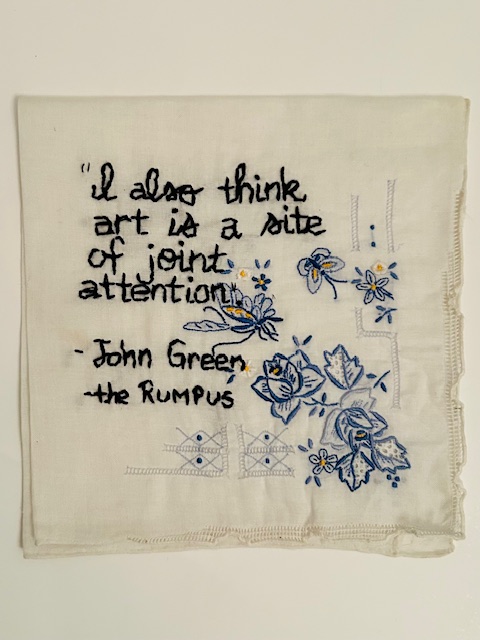
I also think that art is a site of joint attention. When Sarah and I are looking at the same painting, in some ways it’s more connective than when we’re looking at each other.
And I wanted to write about how art, as a shared site of attention, can help us understand and love each other more deeply.