
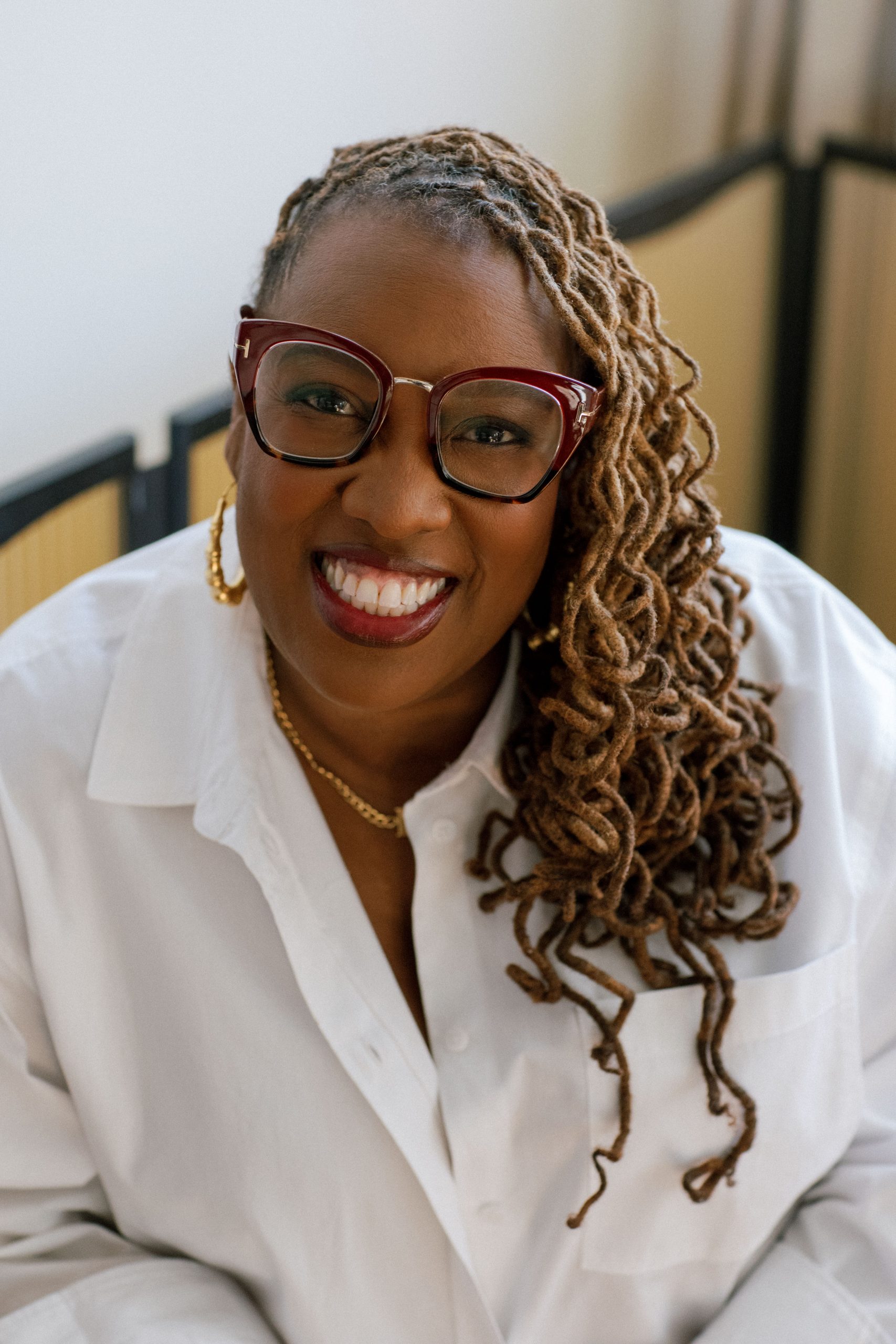
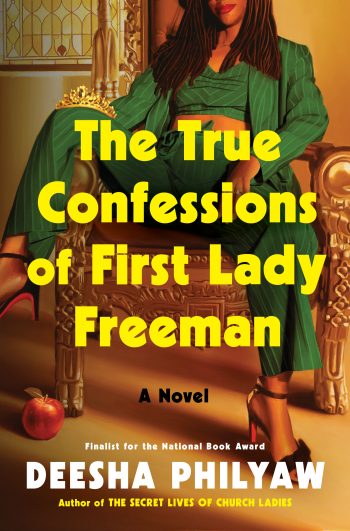
Every now and then a novel comes along that refuses to let its readers remain comfortable. The True Confessions of First Lady Freeman (Mariner Books, 2026) doesn’t simply tell a story, it asks us to reconsider the stories we’ve inherited about faith, family, identity, and ourselves. Deesha Philyaw’s newest novel, after her debut The Secret Lives of Church Ladies (West Virginia University Press, 2020), is by turns hilarious, heartbreaking, unflinchingly honest, and refuses to give its readers easy answers.
First Lady Scharisse “Schar” Freeman has done everything expected of her. She’s a Yale graduate, the devoted wife of Pastor David Freeman, and the somewhat polished First Lady of Hope in Christ Church. She’s spent years distancing herself from the East Side girl she once was, believing that each new accomplishment would bring her closer to acceptance. If only she can win the First Lady USA Pageant, surely she’ll finally become the woman everyone expects her to be. But as Schar herself realizes, “[M]aybe my life as it was needed to be ruined so it could become real.”
Long after turning the final page, I found myself wrestling with questions far larger than the novel itself: Can Black culture exist outside of the Black church? Where do Black women fit within institutions that have so often defined and confined them? And what happens when the life you’ve carefully constructed no longer resembles the person you truly are?
With prose that is as compassionate as it is incisive, Philyaw baptizes readers, immersing us in a story that feels deeply rooted in the traditions, contradictions, humor, and heartache of the Black South. The True Confessions of First Lady Freeman is more than a novel about the Black church; it’s a meditation on identity, inheritance, friendship, womanhood, and the courage it takes to tell the truth.
I had the privilege of sitting down with Deesha Philyaw over Zoom to discuss the novel’s twenty-year journey to publication, writing Black women with honesty and complexity, the complicated relationship between Black culture and the Black church, and why, sometimes, a life really does have to be ruined before it can become real.
This conversation has been edited for length and clarity.
The Rumpus: One of the questions your novel left me wrestling with is whether it’s even possible to separate Black culture from the Black church. So much of who we are, our language, our music, our politics, our sense of community, has been shaped by that institution, whether we still believe or not. As you were writing, were you interested in disentangling those two things, or in showing just how deeply intertwined they’ve always been?
Deesha Philyaw: I was really using the church as it lives because I agree with you that they are absolutely intertwined, even if you don’t ever step foot inside the church. The church influences the culture and it has always been the cornerstone. It was our first institution after emancipation. It’s where our HBCUs and the Civil Rights Movement came from. Our roots are there, but what has grown from those roots is what we call “respectability politics.” It’s fair game for critique. So much of how we move collectively and individually is informed by that, either it’s how we move or how we have had to unlearn how to move. So, in writing the book, it was all one and the same for me. This was a book about shame, misogyny, patriarchy, and getting free from the past.
Rumpus: Women often carry the burden of managing both their own sexuality and the consequences of men’s choices. Why do you think so much of the church’s conversation about sex has historically been directed at women rather than men, and what did you hope readers would notice about that imbalance?
Philyaw: We look at the story in Genesis and the Garden of Eden. Eve was the one who tempted Adam to sin. And we have not stopped blaming women and holding women responsible for men’s behavior ever since.
The idea of women being punished is something that has repeated itself time and time again. They were both banished from the garden, but Eve had to get a little extra pain with childbirth. I would say period cramps too. Let’s throw them all out there. These are texts written by men, but saying this is the word of God. This is our first view of women and it’s how we’re taught to perceive women as not trusting, but also bearing all, bearing the responsibility for everyone and everything. I believe that those are the roots that we see today.
And so while writing this novel, I turned to look at a scripture or something else throughout history and it’s all defending and upholding this notion of women as second class, but also responsible for being examples, pillars, and helpers of men. In Schar’s case, she’s expected to help men, defend men, lie for men at her own expense.
Rumpus: The church functions as far more than a place of worship. It’s a social world, a political institution, a family system, and a cultural archive. Did writing this novel change the way you think about what the Black church has given us, and what it has asked us to sacrifice?
Philyaw: The Black church is not a monolith. So I was very clear as I was writing that this is the Black church at its worst, but this is also the Black Church that many of us know. I’m also grateful for Black churches that are more liberating. Churches that are more women-focused, that are truly women-led, where women are honored. I know that my book doesn’t reflect that, so I kind of had that in the back of my mind—being mindful of that helps make sure that my critique of the church is one that is rooted in love for Black people. I don’t have love for the harm that the institutions have done to Black people, but I didn’t want my love for Black people to be lost in all of that. We caught glimpses of liberation in characters like First Lady Jennifer. She’s the non-judgmental one. Her liberated views in terms of how we should treat each other is what it means to serve God.
Rumpus: First Lady Freeman seems to inherit a lie that where she comes from is something to overcome rather than something to honor. We all know folks from the “East side.” Even after achieving everything she was taught to aspire to, she still feels incomplete. What does the novel suggest about the stories we inherit about worthiness, and how difficult they are to unlearn?
Philyaw: We have to be careful not to go from the frying pan into the fire. When she was living on the East side, she was absorbing all the messages that she was less than. Then she got what she wanted. She marries into what she perceives as respectability. The mistake she makes is feeling as if she has to cut off her past in order to be accepted. She saw the East side version of herself as an embarrassment and understandably, especially when it comes to her Aunt Marie. But she also forgot the fact that it was her aunt who also raised her. She didn’t try to navigate a relationship with her as an adult. Money becomes her answer but we don’t always do better when we know better. She cut her aunt out of her life as representative of her past. Schar had a responsibility to see that relationship through and see what it could become now that she was an adult. If only she would’ve taken a step back she would’ve seen that even dressed up, and all that was behind her, she was still not accepted. The feeling of needing to prove herself to the church was her mistake.
Rumpus: Throughout the novel, characters speak about faith, duty, and protecting others, yet their actions often require them to compromise the very values they claim to uphold. What does integrity mean in a world where doing the right thing may cost you your position, your relationships, or the life you have built?
Philyaw: Integrity is going to cost you something. But I also believe that integrity requires that you are willing to do what’s right despite what it might cost you. Ego, reputation, all your pride, you can either carry ego or be a person of integrity. But when there comes a point where those two clash and you choose ego, you then cannot choose integrity.
There comes a point where you are at a crossroads, and Schar is being faced with people who are supposed to be men of integrity, but they want to protect legacy and pride for the family and for the church. They’re willing to forego being honest and being actually virtuous to keep up the appearance of virtue. That’s the crossroads where Schar finds herself. If she’s truly going to be a person of integrity, she has to tell the truth, and that means that she has to be fully honest about her past and be honest with herself. Integrity is a willingness to hold yourself as accountable as you’re willing to hold others.
Rumpus: One of my favorite qualities about First Lady Freeman is her humor. Even in moments of grief, embarrassment, or uncertainty, she finds ways to make us laugh. Black folks often say, “You’ve got to laugh to keep from crying,” and that spirit runs throughout the novel. Why was humor such an important part of her voice?
Philyaw: Humor really rescued this novel. I wrote Schar as if she was me. I would not like being first lady, so Schar’s beginnings were rather insufferable. But she had this secret anonymous sexy blog where she would write her real feelings and she was funny there.
One of the reasons why I stalled writing this book is because I didn’t like her. I had to learn how to be a better writer, I had to learn how to write a novel to understand that if she got everything she wanted and was unhappy, then she had to want something else for there to be a story. And so I flipped it. What if she loves everything about being a first lady. And then something comes along and threatens to make it all go away? That’s when I had a story.
I had taken a writing workshop on satire. Satire is when you’re really leaning into something to almost severe proportions. So while I was thinking about the fashions, the performance and pageantry of the Black church, specifically embodied within the first lady, that’s when I had the idea to lean so far into those traits and came up with an actual pageant for middle-aged pastors’ wives. And then the fun just flowed from there.
Rumpus: One of the quieter heartbreaks in the novel is the friendship between Petra and First Lady Freeman. As we grow older, friendships often become casualties of changing beliefs, different seasons of life, or simply the people we’re becoming. Why do you think we struggle to acknowledge the grief that comes with losing a friend?
Philyaw: Because we have made romantic love and marriage the milestone for a happy life. We don’t honor our friendships between women in the same way. These are the folks who sometimes have been with us the longest. Society is so marriage-focused (specifically heterosexual marriage), it’s like a box we check off: college, land a great job, marriage.
Society says no matter what else women might accomplish or seek to do, none of that matters if you don’t have a man. I recently read something where someone was saying that women over time (and because of the changes in the culture) have become more independent from men, which is a good thing, but men are still dependent on women because they want us to take care of them and do all the things they don’t want to do—not only the domestic labor, but the emotional labor as well. So as women are becoming more, our worlds are getting bigger and we’re becoming more independent, then the role of a marriage or having a man becomes smaller and that leaves more room for genuine friendships. These friendships should be the anchors of our lives.
Rumpus: One of the greatest compliments I can give this novel is that First Lady Freeman never sounded like a character to me. She sounded like someone I knew: a big sister, an auntie, a woman from church who has finally decided to tell the truth after years of holding it in. How do you write dialogue and narration that feels so authentic to who we are as a people?
Philyaw: I believe we all have it in us. Black people are storytelling people. We relied on stories for survival. And then those of us who were fortunate enough to grow up in intergenerational households, we heard those same stories told over and over again.
I didn’t grow up on the internet, so when I started writing in my late twenties, early thirties, it was the voices of my folks, specifically Southern Black women, in and outside of the church. Just listening to them talk about their lives made me curious about how they navigated the church’s binaries.
I wasn’t brave enough to write my own dissatisfaction. I married a man, had children after being married. I did all of the right things. I thought that I couldn’t talk about being dissatisfied, because you’re not supposed to complain; you’re supposed to be grateful and so my unhappiness was a secret. When I started writing, I gave that unhappiness to these fictional characters, because I wasn’t brave enough to write it as nonfiction. And it was the women that I had grown up with. It was their mindsets, their attitudes, and their voices that came back to me.
Rumpus: How do you know when you’ve reached the end of a character’s story? Is it when every question has been answered, or when the character has finally become someone capable of living with the unanswered ones?
Philyaw: I can hear them. I can hear them before I can see them. It’s important to spend time with your characters so that you can get to know them. They will tell you their story. Sometimes I think authors just need a reminder that it takes time for stories and characters to unfold.
Rumpus: The True Confessions of First Lady Freeman is an honest portrayal of a community that many readers will recognize intimately. When you’re writing about a community you know and love, how do you balance telling the truth with the knowledge that some readers may feel exposed, challenged, or even hurt by what they see on the page?
Philyaw: There’s a quote that James Baldwin has, and he’s talking about the state of the country at the time. He says, I love America more than any country in the world, and because of that, for that reason, I will critique her forever.
I think it’s that your critique can have teeth but your intentions do matter and it’s because you love Black people that you want us to treat each other better.
As a writer, my hope is that Schar will find her readers, people who get her. Getting her doesn’t mean always agreeing with her. She does some things that I wouldn’t do. But that was the best part of the book. That’s what allowed me to write the book, was to free her up to do things I wouldn’t do.
Rumpus: This novel took nearly twenty years to write. With that length of time many writers would abandon a project altogether. What kept calling you back to First Lady Freeman? And what would you say to emerging writers who wonder if they’ve spent too much time on a story or fear they’ll never finish it?
Philyaw: I had this book on the back burner for many years, but Schar kept that burner warm. She was not gonna let me drop the project. I’ve never treated writing like inspiration, or a calling, and no shade to anybody who does—that just wasn’t what it was for me.
I started writing when I was almost thirty years old. Writing to me has always been about craft, learning, problem solving, and figuring things out, and so to that extent that I wasn’t getting it, but I was still curious and interested in this character and in her dilemma.
So I did a lot of reading. I went to workshops. I started talking, sharing pages with friends and getting feedback. When I have talked to people who feel like giving up, it’s because they’re already three steps ahead, which is, “I’m afraid nobody’s gonna want to publish this or I’m afraid I won’t find an agent or get a publishing deal.” Underneath all of that they’re saying, “I’m afraid no one will like my book.”
Those are all very real possibilities, but do you want to write this book even if none of those things happen? I think about what Toni Morrison said, which was if all the publishers disappeared overnight, she would still write. My advice would be to try and get into that mindset. Even if all the publishers disappeared, I really want to write this story.
Whether your book is for a young you, or whoever else, there are people who need your book. They are waiting for your book so that they can say, “Oh, that’s me, or that’s what I went through,” or “Oh, I didn’t know that’s how I could handle that. I didn’t know I could do that. I didn’t know I could say that. I didn’t know I could walk away.” So you have to believe and have the faith that there are people waiting for your book. There will be naysayers, but that’s not why you write. You’re not writing for them, you’re writing in spite of them.