
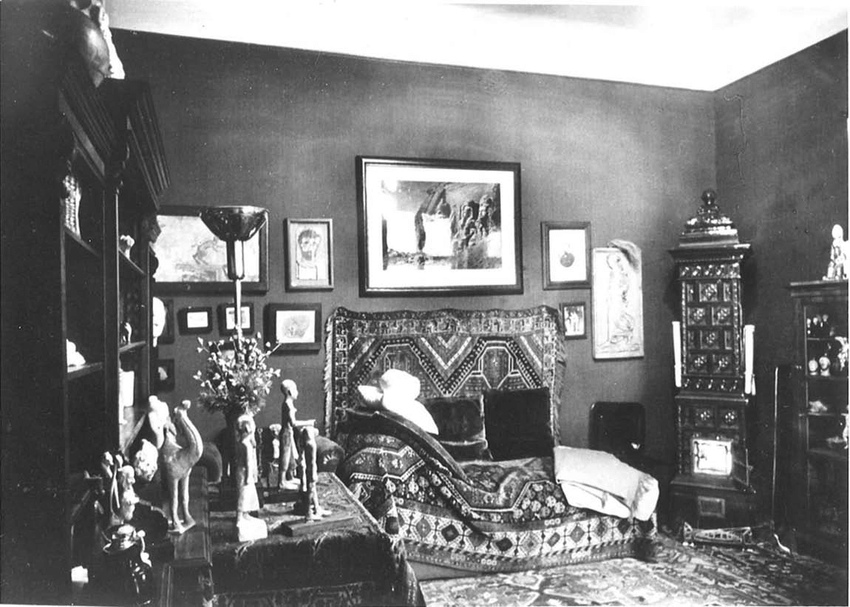
When I had a chance to visit Vienna in 2023, I emailed a college friend who knew the city well to ask for his recommended itinerary.
After listing various museums, walks, and cafés, my friend added, almost as an afterthought, “Of course you could also visit the small, sad, Freud Museum.”
At the time, for some reason, I didn’t ask, “Why sad?”
Instead, with excitement, I put The Freud Museum on our calendar.
In college, a group of us had taken a yearlong survey course, studying Freud’s psychoanalytic theories in a small seminar. Reading Freud’s case studies, I imagined his patients, Dora, or “The Wolf Man,” on the famous chaise, free-associating to childhood memories, unearthing the traumas that caused their symptoms. I’d seen images of the famous consulting room, the desk crowded with Roman and Greek figurines, the psychoanalytic couch draped with an oriental carpet, the shelves lined with Freud’s books and works of art that inspired some of his essays. As the birthplace of psychoanalysis, Freud’s office at Berggasse 19 had been a mental shrine that lived in my imagination for years.
***
In March, my husband and I set out for Berggasse 19, when afternoon light cast shadows from ornamental balconies on building facades. As we approached Freud’s home, I imagined him returning from his daily walks on the Ringstrasse.
We bought tickets at the museum shop and followed the wrought iron balustrades upstairs to Freud’s suite of rooms on the European “first” floor. On the landing, we peered through a lace of etched Viennese glass, admiring the linden trees of an interior courtyard.
Eager to see the rooms where Freud lived for forty-seven years with his family—the scene of his discovery of the language of dreams, a refuge where his patients had confided their deepest secrets—I hoped to experience something indefinable about Freud himself.
As a writer, I wanted to see the desk, still scattered with papers, the signs of a genius at work, to imagine the way he sat, working by the light from the window. In 1991, I visited Casa Azul, Frida Kahlo’s home in Mexico City. We happened to go on a day it was closed to the public, but we found a custodian willing to give us a tour for a small fee. When we entered Kahlo’s bedroom, paints were scattered among dusty medication vials; Kahlo’s mermaid plaster cast, with its lasting impression of her body, lay among the bedclothes. The room still held her spirit.
Ascending the stairs in Vienna, I thought of Freud’s famed cigars.
***
But on entering Freud’s apartment, bare white walls greeted us.
Disoriented, I tried to understand which room was Freud’s study. In one corner, the white paint had been removed to reveal a patch of the original Victorian wallpaper.
Freud’s psychoanalytic couch was nowhere to be seen.
It hit me suddenly.
The Nazis did this.
***
Instead of the rooms I had long imagined, temporary bulletin boards displayed the images of his rooms I’d seen years before. Sterile glass cases exhibited selected artifacts. Some of Freud’s furniture lacked context under bright lights.
In a curtained room, Anna Freud narrated home movies of Freud family gatherings on a continuous loop. Beginning with Freud’s early marriage to Martha, the grainy footage shows him with children, moving on to document the Wednesday Psychological Society, which would later become The Vienna Psychoanalytic Society. The reel glimpses Freud surrounded by children, his beloved dogs, celebrated visitors, and shows him accepting gifts and flowers on his birthday.
But Hitler’s Anschluss, the annexation of Austria in March of 1938, changed the story drastically.
Swastikas draped over the door of Berggasse 19.
The film shows a view of a mass demonstration in Vienna. Hitler cheered on by thousands.
“Look at the crowds,” Anna says. “That’s how it looked.”
In this visceral way, I first learned of Freud’s flight from the Nazis in 1938.
***
In excruciating pain from a series of operations to slow the progress of his jaw cancer, Freud had hoped to die at home. But two days after German troops invaded, a platoon of Hitler’s Stormtroopers, the SA, searched Berggasse 19. The following week, on March 22, 1938, the Gestapo raided Freud’s rooms and arrested his daughter Anna, taking her for interrogation at the former Hotel Metropol at Morzinplatz, the Gestapo headquarters in Vienna. Fearing Anna would be tortured, Max Schur, Freud’s doctor, secretly supplied her with a lethal dose of Veranol.
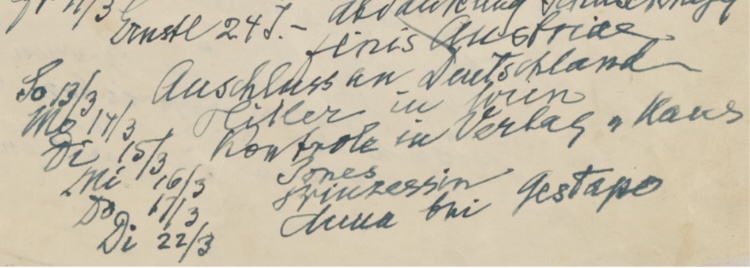
Line near top. “Finis Austereich.” (The end of Austria) Middle line “Hitler in Vienna.” Last line, “Anna at Gestapo.”
Miraculously, Anna was released after a day of interrogation, but the warning had been unmistakable. Her arrest made the family’s flight from Vienna far more urgent. Fortunately, Freud had powerful friends abroad. Freud’s former patient, William C. Bullit, had co-authored work with Freud, and was a close friend of FDR’s. Bullit sent the American consul general, John C. Wiley, to Vienna to bring Freud to safety, arranging for an American diplomatic car to park outside the home to keep an eye on it. Freud’s friend, Princess Maria Bonaparte, arrived within days, and paid the “Reich Flight Tax,” 25% of total assets or income, that the Nazis demanded from Jews leaving the country.
A Nazi official, Anton Sauerwald, had been assigned to oversee the Freud’s financial activities as their “Komisar,” but having read Freud’s work, he falsely certified the family had no foreign assets, allowing them to keep funds they had deposited in Switzerland and elsewhere in Europe. Sauerwald also managed to disguise some of Freud’s art and antiquities as German shipments.
On June 4, 1938, Freud, his wife Martha Bernays, his daughter Anna, the family housekeeper Paula Fichtl, and his medical supervisor, Dr. Josephine Stross, left Vienna on The Orient Express with permits obtained by Ernest Jones, then president of the Psychoanalytic Society. Resting in Paris for one night with Princess Maria Bonaparte, a stay Freud later said “restored our dignity,” they continued to London where Ernst, Freud’s son, had arranged a temporary home. Freud would die of jaw cancer the following year, in 1939, at 20 Maresfield Gardens, now The Freud Museum in London.
But Freud could not save other relatives. Four of Freud’s elderly sisters would be murdered in Nazi extermination camps. In 1942, Marie Freud, Pauline Freud Winternitz, and Rosa Freud Graf, were murdered in gas chambers. His sister Adolfine Freud would die in Theresienstadt, of internal bleeding. In 1942, Ida Drucker, the mother of Freud’s son-in-law, was deported from Biarritz to Auschwitz, where she too was murdered.
After returning from Vienna, I learned that Edmund Engelman’s photographs of Freud’s home are the only surviving record of the interior world of Berggasse 19. They were nearly lost to history.
In 1938, Engelman risked his life to take them. Days after Anna Freud’s arrest, August Aichhorn, a close friend of Freud’s and a practicing psychoanalyst, met with Engelman to make an urgent request. Could Engelman photograph the contents of Freud’s home and offices at Berggasse 19? The Freuds would be leaving in eleven days, but the Gestapo were watching the building. Engelman’s pictures needed to be taken in secret.
Aware of the danger, Engelman later wrote he had undertaken the project willingly, knowing that a physical record of Freud’s historic practice should be preserved. Together with Aichhorn, he believed the pictures might guide a restoration, or a future museum once “the storm of years had passed.”
***
Describing the days he did the photo shoot, Engelman later wrote:
It had only recently stopped raining. The sky was still dark and the cobblestones of Berggasse were glossy and wet. The dark day worried me. I was afraid that there might not be enough light for good interior photographs of the Freud apartment. Flash and floodlights were out of the question. I had been told that the apartment was under constant surveillance by the Gestapo. The only permanent record of the place where Freud had lived and worked for the last forty years would have to be made without arousing any suspicion whatsoever. I felt fear for my own safety and also for the Freuds, for I did not want to be responsible for some misstep which would endanger them now that they were so close to leaving Vienna safely. (Engelman, 1998[1976]: 89)
***
After Berggasse 19 became The Freud Museum in the 1980s, Anna Freud returned a number of artifacts to be exhibited there. In glass cabinets, personal items were pinned by number. I was moved to see things Freud had touched: his iconic glasses, his chess set, a pipe. In another case, a cluster of the antique figurines were a scant gesture that stood in for a collection of 2500 ancient sculptures and cultural objects that had once spilled across his bookshelves and tables.
Engelman’s pictures show that Freud kept dozens of figurines on his desk, including a small figure of Athena, some 12 centimeters in height, carrying a shield, but “missing her spear,” as Freud commented to his patient, the English poet H.D. This was the one statue he took with him as he left the house forever, carrying it to London personally.
***
As I left the exhibit in Vienna, a small pamphlet caught my attention.
After World War I concluded, the Permanent Committee for Literature and the Arts of the League of Nations commissioned Albert Einstein to gather letters from intellectual leaders to serve the common interests of its members in the modern era. Einstein’s first suggestion was Sigmund Freud, and their letters would be published in Paris in March 1933.
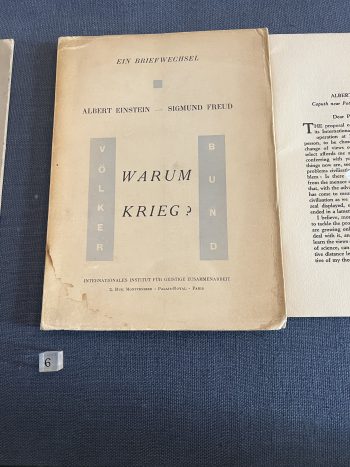
Letters between Albert Einstein and Sigmund Freud.
In his letter, Einstein asks Freud, “Is there any way of delivering mankind from the menace of war? It is common knowledge that, with the advance of modern science, this issue has come to mean a matter of life and death for civilization as we know it.”
Perhaps anticipating modern deterrents of mutual annihilation, Freud answers:
How long have we to wait before the rest of mankind, too, become pacifists? Impossible to say, and yet perhaps our hope that these two factors—mankind’s cultural disposition and a well-founded dread of the form that future wars will take—may serve to put an end to war in the near future, is not chimerical.
Freud does identify the means by which humanity may work toward peace, concluding, “Meanwhile we may rest on the assurance that whatever makes for cultural development is working also against war.”
Published in 1933, Einstein’s letter and Freud’s response are still not widely known. Hitler’s rise to power made the distribution of any work by Jewish authors illegal. In May of 1933, 20,000 works were burned in a bonfire in Berlin, in the square at Humboldt University, with both Freud’s and Einstein’s work consigned to the flames.
Warum Krieg survived the book burning, as did Freud’s writings, reminding me of a line from a Shakespeare sonnet, “Not marble, nor the gilded monuments / of princes, shall outlive this powerful rhyme.”
***
Unlike museums that preserve the original period furnishings of historic figures, The Freud Museum Vienna preserves evidence of Nazi crimes. After the annexation of Austria, Freud’s apartment, like thousands of others throughout Vienna, and Austria, became the target of “aryanization,” the forced sale of Jewish property to Aryan owners.
In her essay, “Seemingly Empty: Freud at Berggasse 19, A Conceptual Museum in Vienna,” Joanne Morra explores the powerful impact of the decision to leave Freud’s home in a state of erasure, rather than repatriating the possessions from abroad. An archival site that contains too many records for a visitor to absorb is paradoxically “empty.” By preserving that sense of absence, Mora suggests the museum more powerfully reveals elements of the past that cannot be restored:
Any endeavor to retrieve and represent the past, to ‘replace’ or ‘reconstruct’ it, is impossible. What this means in light of my analysis is that the aura of these spaces during Freud’s lifetime is irrecoverable, the historical rupture is irreducible, and the images thus function as a loss through and with which we live.
Because Kristallnacht prevented Engelman’s planned escape from Vienna, he was arrested and spent several weeks in a detention camp in France. After “a brief interlude in a French concentration camp as ‘enemy aliens,’” he and his fiancée eventually found their way safely to New York City. After the war, Engelman retrieved his negatives after learning that Aichhorn had given them to Anna Freud before his death, and that she had kept them safe in London.
In 1969, after announcements that Berggasse 19 had been vacated by previous tenants, and would soon house The Vienna Freud Museum, Engelman returned to the apartments he had photographed in 1938.
“I was overcome by the emptiness of the rooms as I walked through,” he wrote. “Mentally, I set all the pieces of furniture in their place. I looked at the wall where the couch had been and noticed, on the wooden floor, the outline of the couch.”
A week later, as workmen were scraping and polishing for the new exhibits, Engelman took one last look at the museum’s progress before leaving Vienna. He closed his memoir with these words:
“The ghost of the couch had disappeared.”
Lead image: Sigmund Freud’s study, Vienna, 1938. Photograph by Edmund Engelman. © Thomas Engelman. Used with permission.

Click here to subscribe today and leave your comment, or log in if you’re already a paid subscriber.