
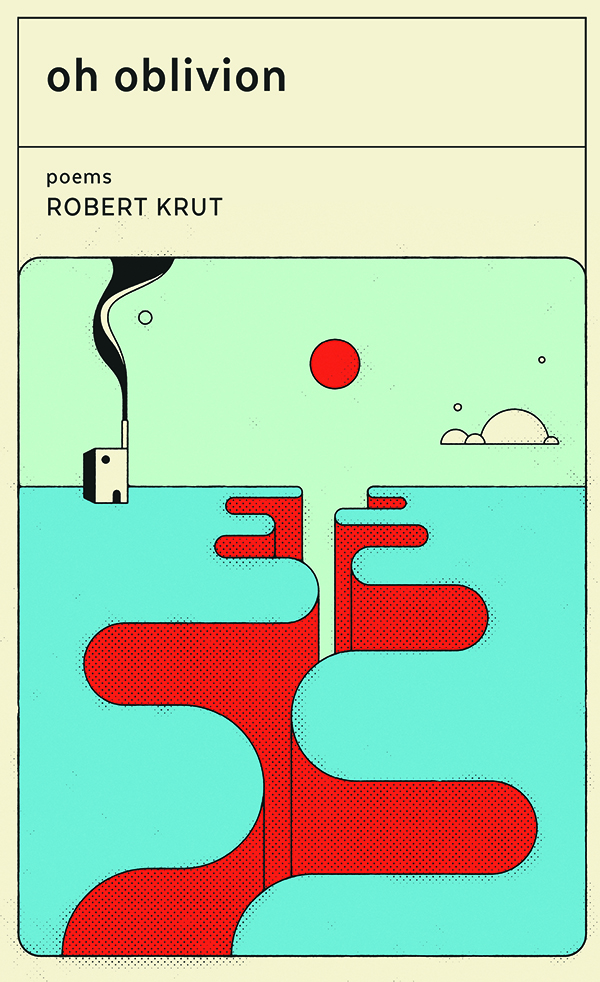
Robert Krut is done with ghosts—or at least, as he intimates in the poem “Oh Amnesia” from his recent collection Oh Oblivion, released on October 21 of 2025—ghosts may be done with him. Or with us. All of us, potentially. After ghost-obsessive collections like 2019’s The Now Dark Sky, Setting Us All on Fire and 2021’s aptly named Watch Me Trick Ghosts, these days Krut strikes a different chord, writing:
The ghosts aren’t watching, hate to say,
they’re off in worlds we can’t even fathom.
We’re nothing more than a dream they can
hardly reassemble as they let a star’s gold
warm their shoulders while they scratch
their backs on the rings of Saturn.
After years tuning into quasi-spiritual dispatches in the midst of exactingly mundane modern circumstances, Krut suggests that the very entities that haunt us have decided to move on. It is the rest of us, the living, who cannot shake that curious, at once vain and mournful, idea that someone might want to spend their afterlife checking in on an existence even more boring than their own. Those everlasting supernatural fonts of inspiration for poets across eras, from William Butler Yeats to Louise Glück, have abandoned the modern age entirely, levitating toward some inconceivable paradise, never again inconveniencing themselves with the paltry problems of humankind. The rest of us are still here, forced to make meaning in a world so often escalating in grotesqueness that the unending onslaught risks tedium.
The rest of Oh Oblivion follows this troubling throughline, with Krut’s refracted view of modern life functioning as a wryly humorous waking nightmare, its horrific visions punctuated by sparse comforts. Krut often mines day-to-day minutiae for resigned comic observation, celebratory of slight human procedures performed to make it through every waking hour, while never losing sight of how these tedious actions function as a kind of grim self-preservation. In “Photosynthetic Self Surgery,” Krut writes “Waking is the anesthetic. Reach / in, remove one lung and the still- / beating heart. I’ll come back to you later.” Shortly thereafter his narrator instructs the reader to:
Take tweezers, tug the splinter
in the bulb of an index finger.Pull out a web of nerves, thin
electricity to set in a glass jar,jittery cylindered filaments. Take
your time, slow your time.
Here, simple chores are radioactive with benignity, dull daily repetition often exploding into day-glo clip-art landing somewhere between midnight reverie and early-morning regret. Something as routine as pulling a lodged splinter from underneath a fingernail becomes a phantasmagorical mindfulness exercise, reminding us that beneath the mundane exterior lies the uncanny—as though removing foreign shrapnel from a personal mass of skin and blood and finding the humanity and tenderness therein.
Often, Krut’s poems begin as twenty-first century self-help guides and curdle toward desperation, as in “Drinking a Single Glass of Water,” a strikingly routine title that precipitates the following opening lines: “Time drinks all our water. The water is gone.” Strangeness stalks the narrators of these poems in the most humdrum of settings, no domestic space free of spiritual alienation. In “Go with Terror,” Krut writes “Across the street, there are organs / hanging in a window like ornaments,” a bona fide physical celebration of horror filmesque depravity, adorning the family home like Christmas decorations, while its occupants squint with suspicion and derision at their surroundings and at one another. Krut writes:
All of the neighbors have been
watching each other through blinds
for weeks, for months, piercing
one eye while an ear winks its drum.
Unsure whom they can trust, these residents silently cast blame on each other while an obviously constructed wind-chime of human viscera stares down their direct line of vision amidst the ceaseless silent accusations. “Go with terror, step outside” says Krut’s narrator—difficult to discern whether said words should be taken as an earnest plea to engage with the fear and paranoia just beyond the front door, or a dire warning to cower inside, seeking refuge from the growing darkness outside the family stead.
As Krut admits, the call is most likely coming from inside the house, anyway. At every corner of these surreal visions, domestic wickedness pours from the bathroom faucet unchecked, overflowing and trickling onto the tile. In this universe, even the Devil is knowable and empathizeable, as detailed in “A Story About the Feast,” where Krut writes: “Satan was a servant, nothing more, meek child at the water’s edge / pulling wings off dragonflies,” the evil spawned by man instead flickering in the shadows located directly behind the kitchen utensils. In a world devoid of spirits to watch over us, the biggest bad of all is reduced to simpering toddler yearning for the same creature comforts as everyone else—ecclesiastic malevolence reduced to routine domesticity. Krut describes Satan thusly:
…a harmless beast, one dull fang
in his mouth, two small horns
like knuckles on his skull,called to the woods by a wind-
voice, the smell of meats,
the sound of pouring wine, a feast
waiting on a branch-split table…
The banality of evil depicted here reframes the grand spiritual wickedness of yesterday as simple grasping toward material pleasure, much the same way Krut’s human figures throughout these poems try to mitigate the hellishness of their surroundings via daily routine. Krut seems to suggest that the very practices that keep us sane and comfortable in our personal lives are also practices that sustain and support outside evils, the consequences of which continuously crop up in the midst of domestic tranquility, constant jagged reminders of a life spent in fear, denial, or both. At this very moment in history, turning on the American television set means tuning into streets filled with masked men stealing reeling innocents away in the night, political chambers run by misshapen sideshow characters whose jowls drip with lechery, petulant greed fueling each hateful maneuver—everyday horrors many would just as soon tune-out in favor of their own private melodramas, pretending as though there is nothing wrong. The suburban home, long a reliable visual indicator of simmering American darkness just beyond the picket-fence, from David Lynch’s free-associative visions to Freddy Krueger’s nocturnal abductions in A Nightmare on Elm Street, has been publicly tried and found not guilty. Who cares that a gnashing wickedness still lurks somewhere in its insulation?
If this all sounds a tad pessimistic (beautifully so), well, maybe fair point. As Krut writes in “The Apple Is an End unto Itself,”
…picking an apple,
slicing it into quartersand burying the core, assuming
it will become a treewhen it will simply be an easily
discoverable treat for a nosy squirrelwhile we eat the fruit, checking
later only to find dirt,moving dirt,
just dirt.
At times, hope for the future feels displaced, or worse, fumbled toward in desperate movements that never quite arrive at their intended destination. As Krut puts it, at the center of it all perhaps there is “just dirt.” But things never stay too depressive for long, as Krut’s narrators are always finding something to celebrate, despite the fact their lived realities keep getting stranger. This is all they can do. “Prayer or toast, don’t know which I’m writing at this hour,” kicks off the narrator of “Oblivion’s Desk,” setting the tone for a collection that veers between desperation and celebration, never quite settling into one mode, the line between the two having been horribly mangled somewhere along the way.
In “Unintended Borders,” Krut finds a shaky optimism when leaving the human and returning to the realm of the animal, writing: “Please help me find our way out or help me build a home. We are owl, we are wolf. We are the blanket.” This turn feels fitting for a collection in which the supernatural has exited the earthly plane in favor of the animal, finding solace in our remaining bestial instincts and our connection to the natural world, rather than in our many human deficiencies. In “An Offering is Infinite,” the narrator pleads:
Please offer me your
hand, give me current, give
me rhythm. I watch your eyes,
your eyes are horizon. Your eyes
are power lines, resting birds.
It is one last cry echoing across a spiritually vacant world, begging, with our dark hallucinations finally vanquished, that we look to each other not with distrust, but with the reminder of our bodies’ paleolithic past. These are stark, sometimes quietly despondent poems that feel like a long exhale but, importantly, are not cynical. Krut does not feel contempt for his narrators, the struggling individuals populating the realities he has conjured, or the circumstances they detail. In fact, the writer seems to be questioning how much grinning cruelty we are expected to endure before we do finally face oblivion. But there is comfort here, a hand on your back: Krut himself understands the impulse to celebrate amidst ruin, however futile. Yes, reading these poems, I was reminded of the grotesquerie of my own daily routine: pumping gas, shoving frozen food in the microwave, scrubbing dirty dishes ad-infinitum until that final bit of caked-on food descends down the garbage disposal. But Krut’s words also, at once disaffected and aching toward intimacy, compelled me to want to get up, hug my loved ones close, and remind them of the meaning they bring in such a farcical and monstrous world. Then, putting the book down, I found myself alone in my apartment, just me and the specters hovering above, haunted remnants of a bygone past—and perhaps they were not even there at all.
Oh Oblivion by Robert Krut
Codhill Press
October 2025

Click here to subscribe today and leave your comment, or log in if you’re already a paid subscriber.