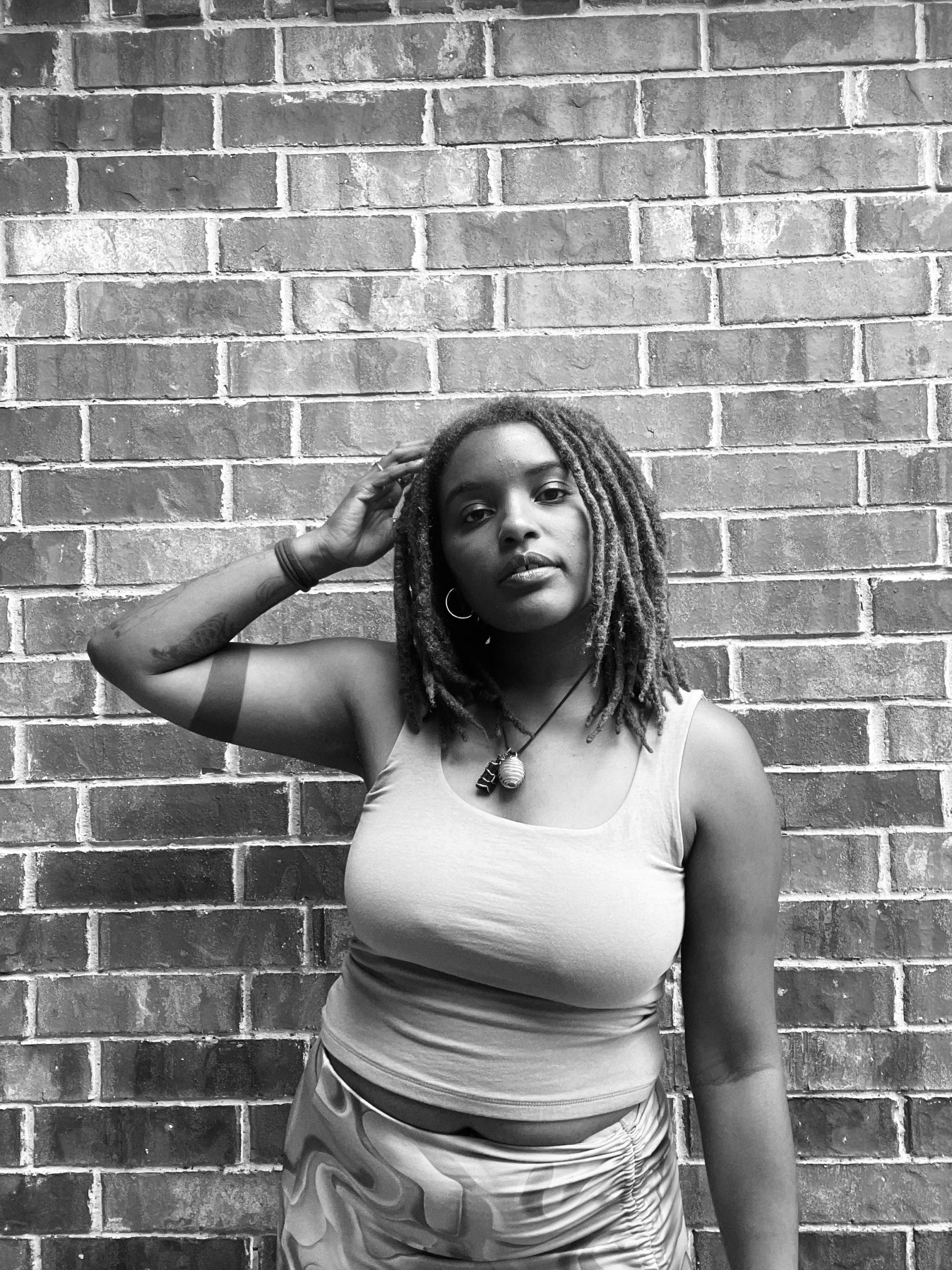
In an interview with Publishers Weekly, Kendra Allen reminisces about her senior AP lit teacher’s advice to never read a book without a pen. Allen credits this teacher with teaching her to read all over again, her advice an invitation to become an active participant in the story. Of course, before any of us yearn to tell our own, we are inspired to do so by the stories we consume. To read with a pen is to do one’s homework. To annotate is to make meaning, to pay homage to the forces that created the author’s voice, and to absorb a bit of the audacity to create for oneself. Allen paid attention, but perhaps she had been doing it all along. She was born in 1994 in Dallas, Texas into an overly-exposed but religious home, among the last years of the full-throated, chest-girded church kids. The fires of fervency were fanned into those of curiosity, not only leading her to question what she was taught, but also leading her to the discovery of her own voice.
For most Black church kids, especially girls, this discovery of one’s voice is a tricky thing, because unless entreated, the church was a place for kids to be silent. That wouldn’t do for Allen. Penning her voice became a place of release, whether it was her trauma, her grief, or simply that much needed exhale. (Church girls tend to hold their breaths in the awaiting of judgment.)
Nudged by an adviser at Columbia College after changing her major three times, she began writing creative nonfiction. As an MFA candidate at the University of Alabama, she won the Iowa Prize for Literary Nonfiction and published her essay collection When You Learn the Alphabet (University of Iowa, 2019) where she went on to publish memoir Fruit Punch (Ecco, 2023), and poetry The Collection Plate (Ecco, 2022).
Her success bore a steep price, the steepest maybe, as each book caused a rift between Allen and her parents. It certainly caused a pivot in Allen’s writing. Without the safety that creative nonfiction afforded her, she abandoned her work and came back to it with even more force in the form of her debut fiction Good Morning Means I Love you (Ecco, 2026). In it, Allen tackles motherhood and postpartum, mothers and daughters, sexuality, community, and all sorts of hard shit, with both restraint and grace.
Allen and I had a delightful conversation via email in which we discussed origin stories, genre philandering, and the very real pressure on Black artists to excel at the “right” kind of work.
This conversation has been edited for length and clarity.

The Rumpus: What is this novel’s origin story? How long have you known you had this story in you?
Kendra Allen: It was all on a whim. I was very tired of writing about myself and in the downtime—for lack of better words—I made up a baby named Night. He was the first concrete character. Then Noon came around again, finally fitting in for good somewhere. He’d been a filler name in everything I tried and failed fiction-wise over the years. So that’s how it started— slowly but surely building upon this family. It took me four years to finish, and the story is still in me, even after it’s done. The entire process felt like shedding a layer of my skin and executive functioning. It’s the first book I’ve written that I’m actually proud of, that I love, that ain’t tied to anything or anyone other than my insides.
Rumpus: I often ask poets and essayists whether or not they write fiction, and it seems like I am asking something dirty, as if art is not malleable. Have you always written fiction? Did you approach this work the same way you do your other types of work? Did you find the process harder/easier?
Allen: Literally laughing out loud cause I definitely used to be one of them people proclaiming I’d never write fiction. I said it so much I ended up subconsciously challenging myself just to see if I could. I had no prior material or life experience to inform the work, the way I had writing about my actual life. But I can’t say I approached it in a distinctly different way. The process is always hard. I always hate it. I like it sometimes. I think I’m the greatest writer to have ever lived. Then I hate it again. So on and so forth—it’s hell, truly—until somebody forces you to let it go. I’d just say it was a humbling experience, both creatively and personally.
Rumpus: Sometimes, I feel there’s a pressure to tell a certain kind of story that paints a more acceptable Blackness; I call them the “Talented Tenth” stories. This is not that. As well, I feel like you refined the idea of both family and community in this novel. It feels quiet, political, raw, and poignant. What prompted you to do this type of revolutionary and subversive work in fiction? What would you say to other writers who don’t feel the freedom to do so?
Allen: This is such a great question and something that deters me from so much stuff people tell me I should like. “The Talented Tenth” Stories is the perfect description and precisely the reason I hate the whole #BlackExcellence movement. Black people being excellent is not few and far between. It just feels like another stamp for white supremacist ideals and respectability politics and to be honest, #WhiteExcellence should be the phrase, because that’s the actual thing we don’t see often. Anyways, anyways, I’m never writing that story. I’m not interested in explaining to white folk how I’m Blackity Black and I’m Black Y’all, the corrected Black, et cetera. Black is the default without pretense and without explanation around here. It just is, and always will be. So what I would say to writers who don’t feel the freedom to do what they want—to be who they are—would be to ask themselves if they even wanna be free in the first place. If you can answer that—and really think about your answer—perception won’t matter and the worlds you make will and can expand. Although the anxiety of whether or not you and what you make will be liked doesn’t leave completely, allowing yourself freedoms (and not getting it right is a big part of freedom) will transform into an ability to conjure fresh ways to portray people’s complexities as is, and not as who we want others to think we are in order to fit, find success, or feel safe. Do what you wanna do, man. Say it how you wanna say it. You don’t have to hold so many hands to feel worthy. You don’t gotta prove your existence to nobody. Dassit.
Rumpus: There is a point in Luther Vandross’s version of “Superstar” where the chorus spirals into a breakdown of voices calling to belong to each other, and this novel feels exactly like that to me. Did you use music at all as a tool to create your work? If you could equate this piece with a song, what would that be?
Allen: I just watched the Luther doc! Music is another one of those things that is always just there; not so much as the driving force that it used to be for me, but sometimes certain inflections, certain pauses, still get me upset, emotional, or like my skin is sizzling. I have a playlist for the book, but if I had to pick one song, it’d 1000% would be “BEADY EYES” by SIPHO. When I say that shit touches my SOUL—every time—it does the thing; the voices, calling out to each other. This is such a beautiful note, thank you.
Rumpus: I immediately thought of A Little Life with the way the melancholy is woven into the narrative of this work. What was it like working on a novel that at times feels chest-breaking?
Allen: Nothing could break my chest more than creative nonfiction, so I already went in with the belief that whatever comes out here—whatever is revealed through these characters—simply can’t be as bad as that. But lemme tell you sum right now; I was very wrong. I was good with what I was doing until it came to crafting Noon’s storyline, which shifted so many times during the years. I’ve written so many beyond personal things, but nothing had ever made me cry while writing. But with him, tears was just falling and falling. It really broke me down, having to admit certain things, certain desires, certain failures. He felt like such a wound up, suppressed person who was working really hard at working really hard in order to not have to feel. So that was hard to think about for me, let alone see and feel it so clearly on the page. But I think the book, as well as myself, came out on the other side of it more loving, more present.
Rumpus: How did you decide when/how to use the metered portions in this work?
Allen: These little shapes is something that started well over a decade ago. I would use the tab bar whenever I got stuck, couldn’t write, or got annoyed with the whole process. I would tap the key over and over and my brain would begin to make these subconscious breaks. These pauses. These places where a comma can and/or should be inserted. And I kept breaking and breaking the line until it felt right—until things began to align in a way that felt sound to my brain. It just kinda stuck. This is before I ever wrote poetry, but the breaks reminded me of songs. Double entendre. Dual meanings, et cetera. And I was tryna figure out a way to mirror it. By the time I got to fiction, my relationship to pace and timing was kinda second nature. It’s slowed down a lot, this little style I’ve formulated, but I follow it when it feels right. I think the difference is with this book, the metered portions are way more intentional. They mean something more. They’re used to confuse the reader about what is actually being said versus how we interpret what is being said. It’s a kind of liminal space, I feel.
Rumpus: Three writers had a baby, and that baby is you. Who are they?
Allen: (I could only hope) but I’ll say my writing is most influenced by Alice Walker, Sharon Olds, and Lil Wayne pre-2010.
Rumpus: You can subtly place your ire in fiction and folk may or may not see themselves/their transgressions in the work, but I see memoir as like this Pandora’s Box of a genre. You could shove it all back in and have what you thought you lost. Would you?
Allen: Fiction has been so surprising for me—especially whenever I have to speak about the book—because for the first time in my writing life, no one is looking at the “I” as me. There’s recourse in assumption, whereas with memoir—with personal narrative in general—you can never shove it all back in. Ever. Not just for yourself, but for others implicated, revealed, or named in your work. I always wanna be upfront about that whenever I teach the essay. It spills over. Yo stuff. They stuff. All of it holey and most times against your will. It just comes with the territory of truth-telling. Or at least, the motivation to search and identify a truth. I think that’s why so many people stray from the genre; at least for as long as they can. They say things like “The people are still alive,” or “What will my family say,” et cetera, et cetera. Because that “I” is so potent, so endless and can’t be attributed to abstraction, it’s rewarding in a long term sense, but the immediate aftermath, if you not emotionally and spiritually prepared for what you’ve produced, that open box start feeling real close to a casket. I still encourage everyone to write about themselves though! But for themselves. Especially Black women and femmes. There’s never enough “I’”s out there for us; just take care of yourself in the process.
Rumpus: Poetry, memoir, essay, and now fiction, what is the genre that you think mostly suits you as a human? As a writer?
Allen: I love this question. It’s something I’m actively tryna figure out. As a writer, the essay is where I began and will most likely be where I end. But as a human? It’s a mix of poetry and fiction. It’s that distance, man. That “I,” never having to be me, that allows me to divulge and draft and desire with full abandon. It’s the only two places where I’m not afraid to state I wanna love and be loved. With essays, sometimes I could live and breathe the style, whereas with the others, the spirit feels a bit more developed, which is weird. I thought it’d be the opposite. I used to think I was so open.
Rumpus: What’s next in the evolution of Kendra Allen the writer?
Allen: I’m currently taking a playwriting workshop, so, we’ll see! Just tryna rediscover my love of words. I wanna have fun writing again, but in a healthier way this time. This decade has to be different, or I won’t do it. Just tryna find my new tab bar. My new shape.